

One Bad Apple…or Battery
You know the old saying about one bad apple causing the whole basket full of them to go bad. The same thing applies to batteries. I am there, now, and so is Mark. Like me, Mark seems intrigued by the Simpliphi lithium batteries, but is also interested in getting a little more life out of what he has. Here’s his note.
Ok, since my 8 Rolls L 16 batteries are 8+ years old, all but one (one cell is 20) are reading good PH, would it be better to get 1 battery new or replace with a Simpliphi? How much do they cost and how many would I need for a 24vDC, 3KW 220 volt a/c system used as a backup on house? It’s the old array and battery bank, we have since added a separate grid intertie array but like both.
We will first consider stretching the life of what you have. I am all for that, but I would NOT buy a new one to mix in with the 8 year olds. Have you given them a good, bubbling equalizing charge? Sometimes that will bring them back.
It may be that you can find a good used one at an industrial battery dealer. Stores like WalMart and Target use L16s in the floor scrubbers and trade them out. Maybe you could pick up a used one, and one that is a better match, for a hundred bucks or so.
Another option would be reconditioning. Here in Pensacola we have an outfit called Battery Guyz that will sell a reconditioned golf car battery for $60 with a one year warranty. Reconditioning includes desulfating, washing them out and refilling with fresh acid. Maybe an outfit like that could refresh your L16.
Now, as far as replacing one of your L16s with a Simpliphi…NO! The L16 is 6v. The Simpliphi is 24 or 48v, depending on the model. You can replace your entire collection of L16s with Simpliphi. Could you keep the one good bank of L16s and run parallel with Simpliphi? I don’t know the battery well enough to answer that question. I have the same question myself as I have two 48v EVs running in parallel to my house banks. It is a possibility I would look into by contacting the company. From what I read about the Battery Mangement System (BMS) I think it is a possibility, but you would probably have to separate the L16s offline when you equalized.
Let’s assume the worst, that we’ll have to swap out them all and start with his L16s’ specs. 8 of them on a 24v system is two strings. Depending on which version he bought, they are good for 390 or 445 amp hours. Let’s just round off to 400 since I hate math. 400ah x 24v x 2sets=19,200. Call it 20kw. Now, you can only safely draw down 10kw, so to replace the entire set of L16s with the Simpliphi 3.8kw units, you’ll need 10/3.8 or 3 of them. Because of all the rounding, they may give a little more drawdown than the 16 Rolls. One Simpliphi, I think, weighs less than an L16, and 3 of them will take up a whole lot less space.
Here’s the kicker. The Simpliphi is rated for 10,000 cycles. That’s more than any other lithium I have seen. 10,000 cycles is 27 years. If you are my age, then that is a “forever” battery. And no maintenance.
You’d have to get with Roberto or Tony for some hard prices, but I would guesstimate that 8 shiny new Rolls L16’s, a premium brand, would set you back around $3000, especially if you throw in postage on those heavy beasts. I think the retail on the Simpliphi is around $3000 each. So you end up paying maybe 3 times as much for 3 batteries as the pile of L16s. Yikes! BUT, now you have more capacity, less maintenance, and may never have to change a battery again. Oh, and bet that if an L16 is $350 today, it will be more 8 years from now!
It’s a bunch of money, I know, but if I am running the numbers right, that sure sounds like a bargain to me. Call Sun Electronics to get up-to-date numbers and an actual quote.
–Neal
Note that earlier I ran the numbers for 16 batteries instead of 8. That gave a completely whacked comparison, but the conclusion remains the same.

Solar Rescue update
Stan called and he was happy.
His old 12v system, pictured above, is really getting tired. It consists of nearly 50 mismatched modules and two windmills in parallel on a single overworked charge controller! His new 24v system is running, but only half-installed and there have been issues.
After our little troubleshooting session the other day, Stan-the-Hermit left the cabin on the creek for a few nights on the beach. He’d returned to the creek to find his batteries were full for a change. Of course, to zing me, he started out like there was some kind of problem.
Best news of all, for the first time ever, he ran his well pump and got all of his tanks charged up so he could bathe. Normally he has to fire up the generator to run the well pump, but it started and the charge held until all four of his tanks were full and the pump shut off. Given that his inverter is of the modified square wave variety, that’s quite a feat, as motors tend to prefer sine wave inverters.
To review what happened, Stan THOUGHT he had 5 of his 10 300+ watt modules connected in parallel to his 60 amp charge controller. Owing to a bad MC4 connector, 3 of them were actually NOT connected. Just as well, because all 5 of them would have exceeded the capacity of the charge controller. We replaced the connector and reworked the arrangement to two series pairs of panels, which reduced the amperage (and loss) on the downlines and gave the controller a little more voltage to work with in the morning and afternoon.
He swears he will finish wiring the rest of the modules and return my big roll of wire. I hope he remembers that if his 60 amp charge controller isn’t big enough for 5 modules, then his new 40 amp controller won’t handle the remaining 6 modules. I’ll be expecting a call next time the sun comes out.
–Neal
Will Has a Question, Part 3 1/2
Here is an interesting battery for Will.
Yes, it HAS been a while since the last post. This time of year just seems to keep me busy.
Last update on Will’s system we essentially concluded he is going to need a huge battery. Batteries should not be a system afterthought. They are probably the most important and expensive part of the system. Do it right and you can minimize having to do it again, unless you can find a “forever” battery.
I know Sun Electronics has several kinds of batteries, because I have been there and seen them. And bought them. The thing is John has all kinds of stuff that never gets shown on the web site until they have a closeout sale. I bet John doesn’t even know what lurks in the back corners. Sometimes it doesn’t hurt to just call them and tell them your situation and maybe they’ll surprise you.
Well, in a conversation with a fellow who got a quote from Tony for a pretty substantial battery, I learned about one that is real interesting. Understand, MY interest because right now I have one bank that is well on its way to ruin and others that are pushing up to 6 years old. I need batteries myself. Golf car batteries are generally considered beginner batteries and the better stuff can cost a lot more. Better can last a lot longer, too, making the expensive stuff cheaper. We’re talking about quality, here.
Well, here’s this lithium battery, the Simpliphi 3.8. It comes in 24 or 48v configuration, 3.8kwh. It is the good kind of lithium, that is they don’t burst into flames. It is much lighter and much smaller than conventional batteries, so if you need a really big (capacity) battery, you don’t have to build a new wing on the house to hold the battery. Apparently the built in battery manager (BMS) let’s you use it like any other battery and, in effect, go to 100% discharge of rated power. The BMS holds the necessary reserve to keep from harming the battery.
So, with a lead acid battery you strive to use less that 50% of capacity to maintain better battery life and the Simpliphi lets you use 100%. That means you have an even smaller pile of batteries in the power room. Throw in a lot more useful cycles (around 10,000) and this battery starts to look economical if you take the long view.
Unit size is 13.5″x14″x8″ and it weighs about 78 lbs. 3 of these weigh about the same as 3 1/2 Trojan T105s and have the usable power equivalent of around 16 of the Trojans! Wow.
It seems there are wall brackets available to fit these batteries, too. Compact, long life, neat installation, no hydrogen or acid fumes and long term economy. What’s not to like?
–Neal
In the News
Just a few notes on solar in the news. Click in the parentheses for the links, since I can’t seem to make them show up in some browsers.
A really biased (headline) blames California power outages on climate change. The actual cause of PG&E outages is PG&E pulling the plug when it gets breezy! Proper powerline maintenance, line stabilizers and right-of-way maintenance to reduce fuel would go a long way to prevent fires from powerline sources. Better forest management wouldn’t hurt, either. Of course, they famously turned off the power to millions and there were fires, anyway. Today it was reported that they turned the power back on and a line fell from one of their newer towers (47 years old), starting another fire. The positive thing coming out is people and businesses are scrambling to find solar and battery solutions to keep their power on and their businesses open. They could learn a lot from John’s customers in Haiti.
Next up is recycling. Solar power has changed so fast that facilities are changing out the panels they installed a few years ago, going for the higher output of today’s panels in the footprint of the old ones. That leaves truckloads of perfectly good panels looking for a new home. That’s just one way John brings cheap panels to Sun Electronics customers. That’s why you can buy a 70 watt panel, single piece, for $12, or as low as $7 in quantity. Or a 300-ish watt panel for a hundred. Another source is insurance claims. It seems that if a half dozen panels get popped in a hailstorm, they’ll go ahead and replace the other hundred thousand, just so they’ll all match. More bargains. You and I putting those surplus panels to work is the best form of recycling. Then there are those that are well and truly smashed. As John has pointed out in his blog, there’s no good way of recycling them, yet. The growing pile is prompting lots of new research on ( recycling and reclaiming. ) Of course, there are new surplus modules, too. Companies go bankrupt or get into some sort of bind and there’s another container load of them.
Finally, something fun. Are you wanting to try your hand at solar power? Is your kid looking for a science fair project. Check out the American Solar Energy Society’s ( Tiny Watts) program. Program members build their tiny watt phone chargers, battery chargers, portable lights and all sorts of things. I guess the solar toys John used to have would qualify. I put a solar powered spider on the table in Mom’s sun porch and it would drive her cat nuts! Inspired by Solar George, down in the Keys, I found a couple of 6″ panels from a yard light and will turn them into USB chargers. I figure you can use them directly to charge a phone, but I will go one better and let it charge one of those USB battery boxes. The battery box, using 18650 cells reclaimed from my pile of old laptops, can then charge two phones any time of the day or night. What kind of Tiny Watt project can you make? Check the link, above, for ideas.
–Neal
Don’t Do This!
This morning, going through the email editions of American Solar Energy Society’s Solar@Work and PV Magazine, I came across an article on things found wrong during inspections of photovoltaic power systems, both at home and commercial installations. You might want to take a look at the article and then take a look at your own system! https://pv-magazine-usa.com/2019/09/19/solar-power-installation-techniques-dont-do-this-w-pictures/
–Neal
A Hot Time at WalMart
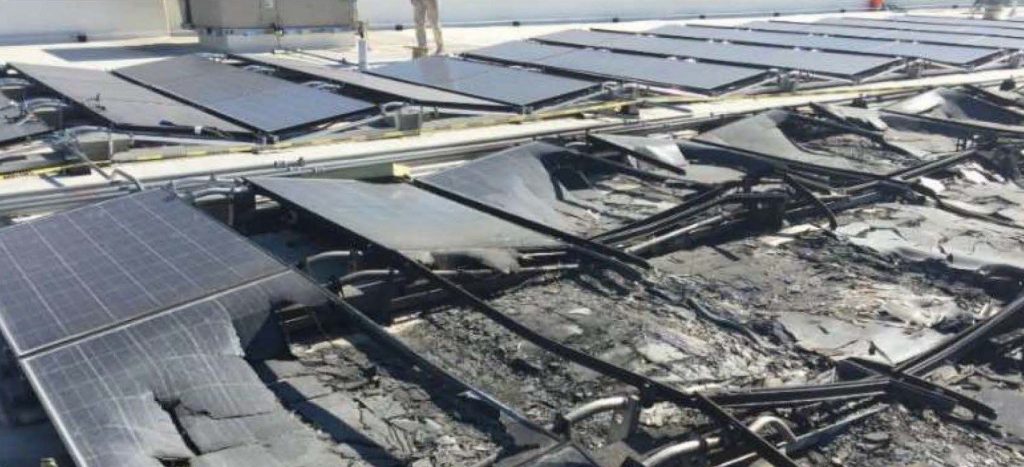
Don’t Try This at Home
Did you hear about the solar panel fires on the roofs at various WalMarts? Don’t let it happen to you!
Little bits and pieces of this story have been coming out in the solar trade press for a few weeks, now. What I have gathered from this is that the rooftop solar power systems at 7 WalMarts have caught fire. The roofs were steel and the stores were not extensively damaged, but the WalMart folks are miffed enough to sue Tesla over the affair. Elon Musk’s Tesla did not install the systems, but they bought out Solar City, so it is a mess they inherited. Since Solar City was started by some cousins of Musk, you can wonder if the next family reunion might be a little tense.
So what does this have to do with you and YOUR solar power system? Maybe nothing and I bring it up so that we can make sure. It is looking like the problem started with connectors. Most of the panels I have came with MC3 or MC4 connectors and I have worked with Tyco connectors. MC3 and MC4 won’t fit together. Just a glance and you know that. MC4 and Tyco connectors look just alike, but won’t fit together. That’s good because the lookalike parts have just the opposite polarity. You will have to use adapters to mate these up.
The WalMart problem seems to involve mixing MC4 and Amphenol H4 connectors. They look alike and they fit. Amphenol makes no claim that an H4 is an MC4-compatible connector and vice-versa. The problem is, the Solar City installers used them interchangeably and the fit is a little sloppy. Word is, Solar City knew of the problem and had begun a program of swapping out for truly matching connectors. They just didn’t get to some in time and now the lawyers are swarming.
Something that can exacerbate the problem is not plugging them in tight, even when everybody is using the same connector. Sometimes MC4s are really quite snug, getting that rubber seal seated. When locked they can be a real pain to get unlocked, if you are experimenting and it would be really easy to forget and leave a connection half done. Aside from a loose fit, that could be an invitation to water and corrosion.
In a low voltage system you might never have an issue with loose or mismatched connectors, but in grid tie, you can get into many hundreds of volts and a fair number of amps, resulting in conditions that will start and sustain an arc long enough to melt and then ignite connectors, which in turn can melt and ignite something else. Like a roof.
If your solar was installed by Solar City, have they come by to check
and update your system? Maybe YOU should. Of course, it is a good
idea to periodically check your system because STUFF HAPPENS, regardless
of who installed it. Are all the connectors snug and not charred or
melted? Does the insulation look good? Any brown patches or cracks on
the modules? Battery cables tight? You know what it is SUPPOSED to
look like, so just look for anything that doesn’t look right.
Safety first!–Neal
John’s Home Office Solar Backup Power System
Condo Solar
As promised, I am passing along John’s description of the emergency backup system he put in his condo, years ago. Battery backup, with solar and a generator. The power does not usually stay off very long in big cities, but it doesn’t have to go off at all!
When I started Sun Electronics 35 years ago, I used my home office, it had been my Kyocera America East Coast and Latin America office. I set up this new office for Sun Electronics after working for them for 8 years.
I installed about 5 ARCO modules on my balcony railing , they were flat so I could use them as a bar for parties and just hanging out watching a nice view of the pool deck, Biscayne Bay and the Ocean. They were the perfect width and length 4 ft, by 1 foot. They were just for the office, then I added, a separate circuit breaker sub panel and added a Trace DR2424 inverter charger with an automatic transfer switch so I could have a hybrid system using a portable silent Honda portable gas generator. I could plug that back into grid to use for black outs or, by disconnecting the utility, and keep running the condo, ( the most important electric circuits: 2 refrigerator freezers (25 years old) sockets in kitchen, bedrooms and living room, minus the big loads 220 VAC appliances like stove, electric water heater and air conditioner. It was a great little hybrid system. We only integrated the Generator because Hurricane Wilma came along and put Miami back into the dark ages for 3 days. The system was so efficient and quiet that no one could see the solar panels and when the hurricane showed up we took them down and just used the backup power system with the Honda generator inverter, and 4 6V, 220 amp hr batteries wired in series (equaling 24 volts).
We went three days on that system and didn’t even use half the gasoline in the little lightweight portable, practically silent, generator because most of the time we didn’t need it after the batteries were charged and they took over we just had to disconnect the extension cord running to the generator out on the balcony that fed the house and the 70 amp battery charger in the inverter/charger.
It reminded me of the pelicans that flew by my window everyday up on the 14th floor Venetian Condominium. They’d flap their wings a couple of times (the generator) and then glide half a mile or more (the inverter output off the batteries, no noise, not even the Honda that I don’t think anyone ever noticed. Its illegal to bring gasloline into a high rise for running a generator on your balcony so we brought it up full in a cardboard box just before Hurricane hit, It was amazing to see all of Miami dark for three nights. If it had lasted more than one tank of gas I would have just reinstalled the panels on the balcony railing and lighten the load by at least half, goodby refrigerators, 6, 35 watt modules weren’t capable for that, but everything else was ok including microwave and fans a small 10 cu. Ft. refrigerator (75 watts) could have been added but just never did that.
Let us know how it goes
If you are in the storm zone, we wish you all the best. If you have a backup power system that survived or can cobble something up, let us know what worked. If your system failed, let us know about that, too, so we can learn from it.
I spoke with John Sunday night. The blogs have been getting an overhaul and he is having trouble making posts, so I thought I’d let you know that he and the family flew out west to wait it out.
They are fine, but yes, he is worried about his home, the business and you, the customers.
The storm really made a mess of the Bahamas, and though nobody really knows what will happen, it looks like Miami is in good shape. Just a wiggle to the west and it could get really bad up the state or in Georgia or the Carolinas. Cross your fingers.
Right now it is 0330, Monday morning, and I don’t have all my resources, but will soon tell you about some of the discussions John and I have had about emergency power, including how he rigged a system in his his hi-rise apartment. Check some of the other blogs for tips too–Neal
Can I Do It Myself?
So you’ve been thinking about solar power or battery backup and wondering, “Can I do it myself?” Well, let’s stop for a moment if you really meant, “May I do it myself?” Those are two different things and I’ll talk about both, separately, but I wanted to point out both considerations. Without any more information, I’d say, “Maybe” to both.
Can you? Let’s talk about the physical requirements. I’m 65 years old, am 30 pounds too heavy, have too much blood pressure and all the bendy parts don’t bend like they used to. I know two other guys my age doing solar and one 75 year old. If you aren’t much worse off than that, you have potential.
This is my current project, in Phase 3. I call it my Solar Shed, with 11KW on the roof.
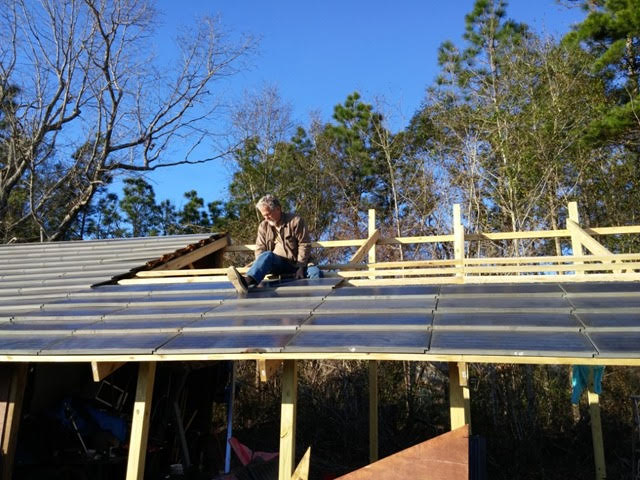
Can you pick up a 65 pound solar panel or battery? Lift the panel over your head? Somebody’s going to have to do it and it won’t climb up on the roof or rack by itself. There will be heavy stuff.
Are you clever enough to come up with some apparatus or con a buddy to help you lift a 200 pound inverter in place to bolt to the wall? Sometimes a good idea works better than brute force. Ratchet straps can raise a heavy inverter.
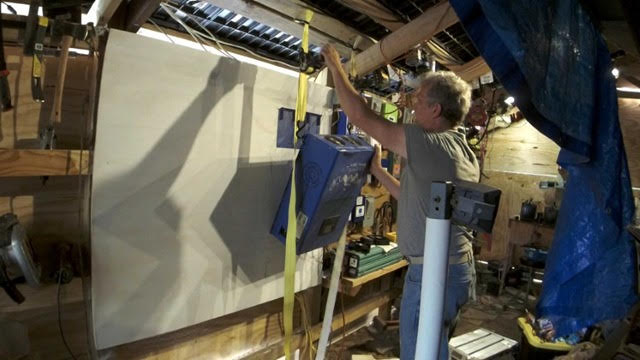
Do you have the tools? In addition to the usual hand tools, you may need big cutters, crimpers, soldering supplies, a basic volt/ohmmeter, ladder, screw gun and maybe more.
Do your tools have a lot of blood on them? None means you aren’t using them or are good at cleaning up. A little is inevitable, but too much may be a message to hire a pro.
Do you get gifts of tools at birthday and Christmas? If so, you may be ok. If not, why not? Do people think you are dangerous with a tool? Do family members run to call 911 when they see you with a power tool? Some people are just not meant to use tools.
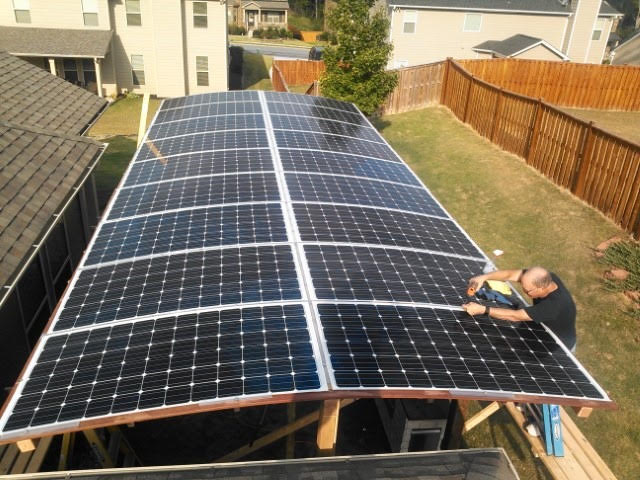
Can you successfully, rewire a lamp, assemble a kid’s swing set or Ikea furniture or install a car stereo? If so, you may be ok. Courtney, 64, puts in the last screws in an arched solar pergola over his BBQ. Yeah, we bent them.
Do you have the knowledge of how solar power systems are connected and regulations for connecting them? If you don’t, there is a lot of free information on the Internet, diagrams of sample systems are available and folks like Sun Electronics offer kits and pre-fab hardware that requires minimal connection.
Those are very convenient and can save money over a la carte. You can get loads of ideas by downloading free back issues of Home Power Magazine at https://archive.org/details/home_power_magazine .
Tom is 75 and he’s doing his own 10KW solar
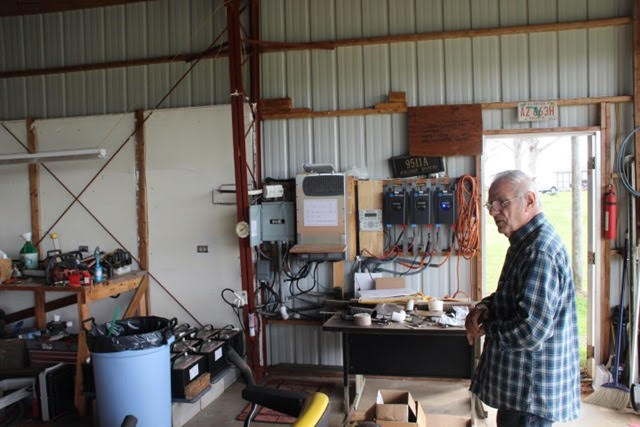
There are a couple of things I want to warn you about that may not be obvious to a newcomer. Most solar panels put out a modest voltage of 18-40 volts. That might give you a little tingle if wires were on a sweaty arm, but individually solar modules are pretty safe. HOWEVER, if you are using an MPPT type charge controller on a battery system (and you should for efficiency), you might have several panels wired in series for maybe 120-150 volts going into the charge controller. That much is going to do you harm if you touch it. Your panels normally use MC3, MC4 or Tyco connectors that won’t let you touch the harmful voltage, but you will use bare wire to connect to disconnects, fuse holders and the charge controller. I make a point of doing the bare wire work before plugging in the last panel connector and I’ve not been bitten yet. In my early days as a broadcast engineer I routinely worked with radio transmitters with 10,000 volt power supplies. My boss told me to always keep one hand in my pocket so that I couldn’t make a circuit through my heart if I slipped up. I never wore rings or a watch to work, either. Insulated gloves are a good idea, too.
64 year old Stan is upgrading the solar at his hunting camp.
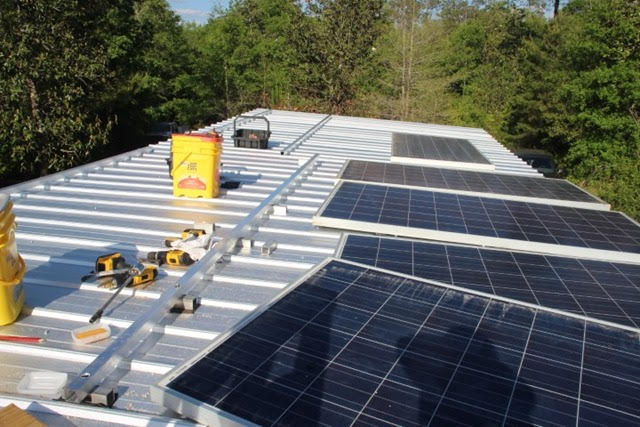
Now if you think 150 volts is worrisome, and it is, consider that if you are connecting a grid tie system, you may be dealing with 600 volts!!! Now, aside from my advice to “DON’T TOUCH”, there is a characteristic of DC power of which you might not be aware. It arcs. If you try to unplug one of your MC4 cables while the system is charging or grid-tied, there is a good chance that the current will try to continue to flowing in the form of an arc. This can vaporize a connector, which will have to be replaced. Do your unplugging at night or when the system is shut down.
Did the last two paragraphs frighten you or did you just store that info away? If it scares you, you might start on something simpler or just call in a knowledgeable friend or a pro. If not, and you aren’t any older or feebler than I am, go for it! The hardest part may just be deciding what you want to do.
I take my solar power on adventures….or it takes me…thousands of miles.


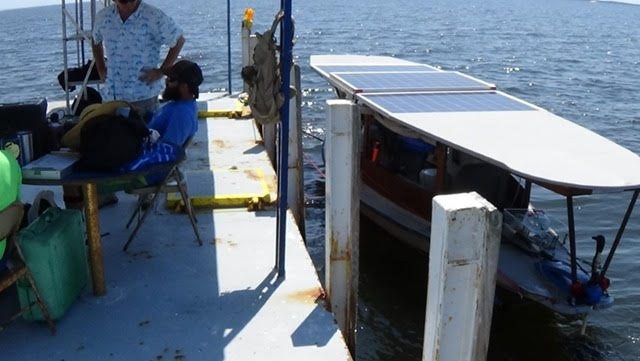
One last thing, if you want to get some construction experience, working with laying out the structure, framing, roofing and wiring,—maybe even solar— consider volunteering with Habitat for Humanity or one of these groups that builds houses for disabled vets. You will learn skills, build confidence and find out if you are made for this sort of thing. —Neal