

Don’t Do This!
This morning, going through the email editions of American Solar Energy Society’s Solar@Work and PV Magazine, I came across an article on things found wrong during inspections of photovoltaic power systems, both at home and commercial installations. You might want to take a look at the article and then take a look at your own system! https://pv-magazine-usa.com/2019/09/19/solar-power-installation-techniques-dont-do-this-w-pictures/
–Neal
A Hot Time at WalMart
Don’t Try This at Home
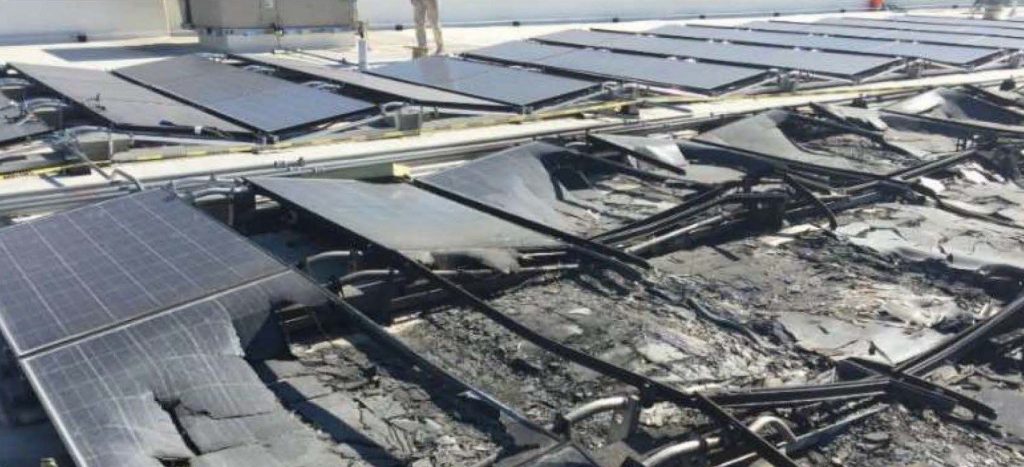
Did you hear about the solar panel fires on the roofs at various WalMarts? Don’t let it happen to you!
Little bits and pieces of this story have been coming out in the solar trade press for a few weeks, now. What I have gathered from this is that the rooftop solar power systems at 7 WalMarts have caught fire. The roofs were steel and the stores were not extensively damaged, but the WalMart folks are miffed enough to sue Tesla over the affair. Elon Musk’s Tesla did not install the systems, but they bought out Solar City, so it is a mess they inherited. Since Solar City was started by some cousins of Musk, you can wonder if the next family reunion might be a little tense.
So what does this have to do with you and YOUR solar power system? Maybe nothing and I bring it up so that we can make sure. It is looking like the problem started with connectors. Most of the panels I have came with MC3 or MC4 connectors and I have worked with Tyco connectors. MC3 and MC4 won’t fit together. Just a glance and you know that. MC4 and Tyco connectors look just alike, but won’t fit together. That’s good because the lookalike parts have just the opposite polarity. You will have to use adapters to mate these up.
The WalMart problem seems to involve mixing MC4 and Amphenol H4 connectors. They look alike and they fit. Amphenol makes no claim that an H4 is an MC4-compatible connector and vice-versa. The problem is, the Solar City installers used them interchangeably and the fit is a little sloppy. Word is, Solar City knew of the problem and had begun a program of swapping out for truly matching connectors. They just didn’t get to some in time and now the lawyers are swarming.
Something that can exacerbate the problem is not plugging them in tight, even when everybody is using the same connector. Sometimes MC4s are really quite snug, getting that rubber seal seated. When locked they can be a real pain to get unlocked, if you are experimenting and it would be really easy to forget and leave a connection half done. Aside from a loose fit, that could be an invitation to water and corrosion.
In a low voltage system you might never have an issue with loose or mismatched connectors, but in grid tie, you can get into many hundreds of volts and a fair number of amps, resulting in conditions that will start and sustain an arc long enough to melt and then ignite connectors, which in turn can melt and ignite something else. Like a roof.
If your solar was installed by Solar City, have they come by to check
and update your system? Maybe YOU should. Of course, it is a good
idea to periodically check your system because STUFF HAPPENS, regardless
of who installed it. Are all the connectors snug and not charred or
melted? Does the insulation look good? Any brown patches or cracks on
the modules? Battery cables tight? You know what it is SUPPOSED to
look like, so just look for anything that doesn’t look right.
Safety first!–Neal
John’s Home Office Solar Backup Power System
Condo Solar
As promised, I am passing along John’s description of the emergency backup system he put in his condo, years ago. Battery backup, with solar and a generator. The power does not usually stay off very long in big cities, but it doesn’t have to go off at all!
When I started Sun Electronics 35 years ago, I used my home office, it had been my Kyocera America East Coast and Latin America office. I set up this new office for Sun Electronics after working for them for 8 years.
I installed about 5 ARCO modules on my balcony railing , they were flat so I could use them as a bar for parties and just hanging out watching a nice view of the pool deck, Biscayne Bay and the Ocean. They were the perfect width and length 4 ft, by 1 foot. They were just for the office, then I added, a separate circuit breaker sub panel and added a Trace DR2424 inverter charger with an automatic transfer switch so I could have a hybrid system using a portable silent Honda portable gas generator. I could plug that back into grid to use for black outs or, by disconnecting the utility, and keep running the condo, ( the most important electric circuits: 2 refrigerator freezers (25 years old) sockets in kitchen, bedrooms and living room, minus the big loads 220 VAC appliances like stove, electric water heater and air conditioner. It was a great little hybrid system. We only integrated the Generator because Hurricane Wilma came along and put Miami back into the dark ages for 3 days. The system was so efficient and quiet that no one could see the solar panels and when the hurricane showed up we took them down and just used the backup power system with the Honda generator inverter, and 4 6V, 220 amp hr batteries wired in series (equaling 24 volts).
We went three days on that system and didn’t even use half the gasoline in the little lightweight portable, practically silent, generator because most of the time we didn’t need it after the batteries were charged and they took over we just had to disconnect the extension cord running to the generator out on the balcony that fed the house and the 70 amp battery charger in the inverter/charger.
It reminded me of the pelicans that flew by my window everyday up on the 14th floor Venetian Condominium. They’d flap their wings a couple of times (the generator) and then glide half a mile or more (the inverter output off the batteries, no noise, not even the Honda that I don’t think anyone ever noticed. Its illegal to bring gasloline into a high rise for running a generator on your balcony so we brought it up full in a cardboard box just before Hurricane hit, It was amazing to see all of Miami dark for three nights. If it had lasted more than one tank of gas I would have just reinstalled the panels on the balcony railing and lighten the load by at least half, goodby refrigerators, 6, 35 watt modules weren’t capable for that, but everything else was ok including microwave and fans a small 10 cu. Ft. refrigerator (75 watts) could have been added but just never did that.
Let us know how it goes
If you are in the storm zone, we wish you all the best. If you have a backup power system that survived or can cobble something up, let us know what worked. If your system failed, let us know about that, too, so we can learn from it.
I spoke with John Sunday night. The blogs have been getting an overhaul and he is having trouble making posts, so I thought I’d let you know that he and the family flew out west to wait it out.
They are fine, but yes, he is worried about his home, the business and you, the customers.
The storm really made a mess of the Bahamas, and though nobody really knows what will happen, it looks like Miami is in good shape. Just a wiggle to the west and it could get really bad up the state or in Georgia or the Carolinas. Cross your fingers.
Right now it is 0330, Monday morning, and I don’t have all my resources, but will soon tell you about some of the discussions John and I have had about emergency power, including how he rigged a system in his his hi-rise apartment. Check some of the other blogs for tips too–Neal