


Cool Running
We surely do get spoiled by some of our modern comforts, don’t we? When I was a kid, we didn’t have air conditioning at the first 3 houses in which I lived, nor at school. Our first car with a/c was a ’65 Pontiac. Although I don’t crank the thermostat down low, I still like to have it to knock down the humidity and cool down on those muggy Florida afternoons. One of the goals I have been working toward is to get the house’s central a/c on the solar. It is a big part of the power bill, so it is a good goal. I used 215 kwh from the grid this past mild month and would like to keep it close to that through the summer, instead of the 1500 kwh (or more) that my neighbors will use.
A few years ago, as an experiment, I parked Sun King (my solar launch) next to the house and ran a line from the boat’s inverter to a window a/c. It worked great, but a 5000 BTU window unit is not what you need for a two-story house. My first attempt at running the central unit on my 24 volt system almost worked, but only because I was low on freon. All charged up, I couldn’t quite get over that startup surge. It is probably just as well because I discovered that the transformer in that cheap Chinese inverter was just a wee bit underrated and would have melted running the a/c all day.
I know my 12kw inverter would have run it because it worked for the guy from whom I bought it…but lightning fried that hope. My homemade 5548 has a huge transformer and will put out thousands of watts continuously, but it still could not deal with that starting surge. I probably could have tweaked the overload settings, but it works fine, otherwise, and I did not want to break it. Should I give up? Ohhhh, no. In a case like this, we simply need to change the rules.
This surge problem doesn’t just come up when running on an inverter, campers and boaters like their a/c, too, but sometimes end up getting a really big generator to run it. My friend Courtney has a huge bus with a big, rumbly Onan generator. Run the thermostat down and that Onan acts offended when the compressor kicks on. After that first couple of seconds, the Onan settles back into its lazy rumble, but you can tell it doesn’t like the startup.
But, dig around on the internet and you’ll hear guys talking about running a one-ton or even an 18,000 BTU a/c on a Honda 2000 generator! What? I can’t run an 18,000 BTU a/c on a 5500 watt inverter, but they can run on a 2000 watt Honda? Let me give you a hint: they cheat. They changed the rules.
If you are looking to install a new a/c, one of these new-fangled inverter mini-split rigs might be the way to go. When they say “inverter” they mean a variable speed motor controller. A few makers put inverter compressors on full size systems, too. If you’ve not seen these, or paid attention, these units start the motors up slowly and run just fast enough to maintain the temperature you set. It really is hard to tell the things are running! In addition to eliminating the starting surge, you may end up using half as much power in the long run with units up to a SEER 25 rating. For comparison, my 30 year old unit is a “High Efficiency SEER 13” model. You’ve seen the TV commercial with the old a/c unit quivering, rattling and giving off a puff of smoke? That’s mine.
Yeah, but if you are like me and are not too keen on spending 6 grand to replace something that still works and will run on FREE electricity (assuming I can get it to run at all) you may want to “cheat” like those campers and boaters are. You see, there is a thing called a “soft start” that emulates the slow spinup that the inverter units use. They sell under the trademark names of Dometic SmartStart and Hyper Engineering Sure Start. They aren’t cheap, listing around $600, but you can shop around. I found a couple for my units for $100 each from a marine salvage dealer. Buying something used without documentation may not be something you’d feel comfortable installing yourself, so you might hire that job out or get your HVAC dealer to come up with one.
Changing the Rules: SmartStart on my A/C
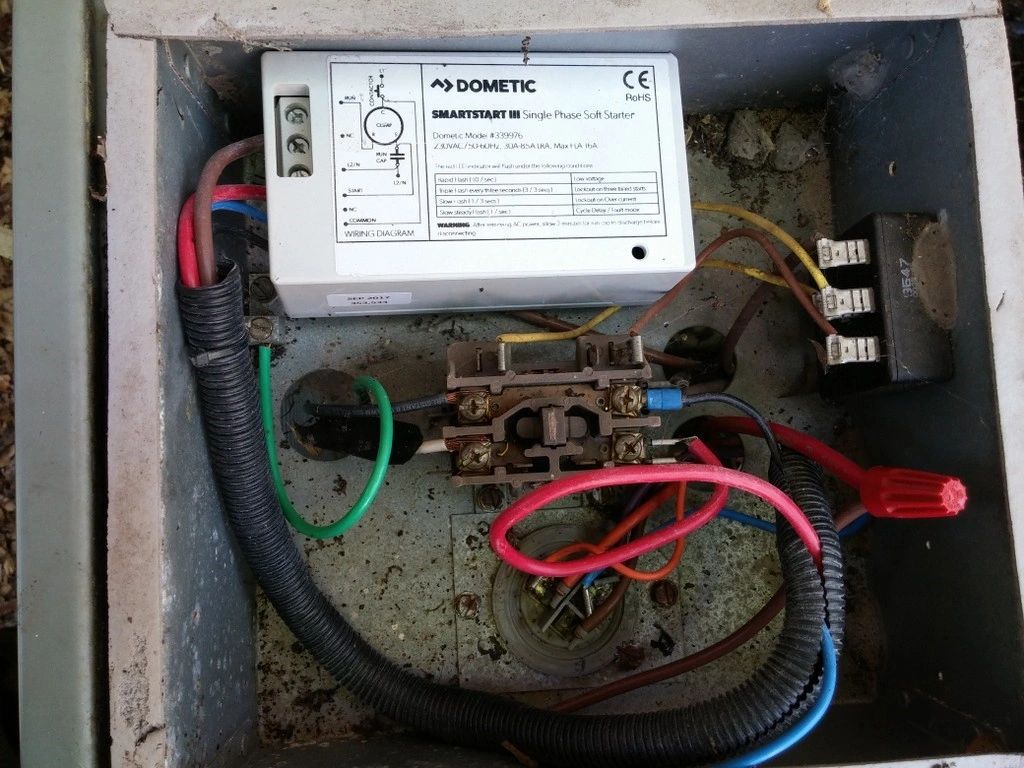
When the time came to give it a try, one of the golf cars was charging and the refrigerator was in auto-defrost mode, so there was already a good load on the inverter. I ran down the thermostat and the lights gave 3 little flickers as things began to run. The starter has a microprocessor that learns the load and afterward the startup was so gentle you had to watch for any flicker at all. I would say it dims the lights less with everything on the solar power than it did when everything was on grid, without the starter. Once underway, the compressor is pulling maybe 1800 watts and plugging in the golf car or firing up the Keurig while the princesses are watching Disney in the living room still leaves power to spare. The one unit upstairs will cool the whole house, but I will go ahead and convert the downstairs a/c, too, when I get the 10kw inverter built.
What about nighttime? I do not have enough battery to run a lot at night, but I have a plan. Using the programmable thermostat, I will really cool down the house during the day. When you are active, a little cooler feels good, anyway. Then, late in the afternoon, I’ll run the thermostat up a few degrees. The thermal mass of the drywall will hold that cool for quite a while, maybe even until morning, if it isn’t just awfully hot. I have no doubt the average house temp will be cooler than it has been when I was paying for those overpriced kilowatts from my power co-op.
So, success at last! The only problem is we have a cold spell for the next week or so and I don’t need a/c! That’s ok, the heat will come, eventually, and I will be ready. What about you? Are you up for getting a little more comfort out of your solar power?By: Neal Collier
Battery safety tips
Bring a big truck when you visit and work safe when you get home.I write this stuff for fun and to be helpful. I’m not an employee of Sun Electronics, I’m a customer. In my role as customer, I set out the other afternoon for my third visit to Sun’s Miami headquarters and my first visit to the Miami Lakes facility. This place is a lot nicer than the Miami Gardens warehouse, though it lacks the artistic touch left at the old place by some tag artists.
It is a round trip of 1482 miles for me, so I like to make a good haul of it. I brought my big trailer. We stacked panels until the fenders rested on the tires and I made the decision to leave two pallets behind. 14kw will keep me busy for a while, anyway. I also didn’t get as many batteries as I wanted. Upon calculation back home, I figure I brought home close to 6000 lbs. I could have carried that extra stuff, after all! We just needed to pry the fenders up a little further off the tires.
Live and learn.
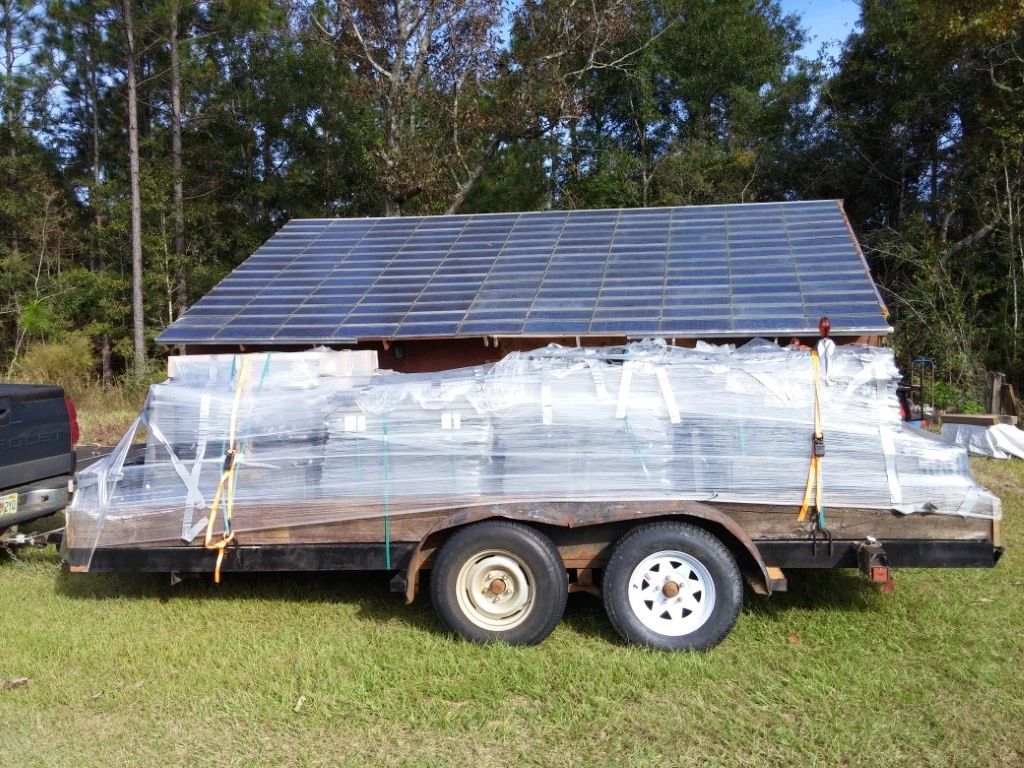
Well, back home, I had some ideas how I was going to treat the batteries on my new 48v system a little differently. I like to improve safety and efficiency as I go. I know ways of doing it wrong, both from investigation and from practical experience. One of the easiest ways of blowing up some batteries is to hook them up backwards. The things are marked plus and minus and we all know not to mess up the connections, but you get tired, the area may not be well lit and the batteries may have some dust or baking soda on them to obscure the markings molded into the cases. Furthermore, those pesky cables get in the way! Believe me, you CAN hook them up wrong and I HAVE done it and didn’t like how it worked out.
First thing I did before taking them off the tailgate was to hit the POSITIVE corners with a dash of white paint. I thought about red but Trojan batteries are sort of red, so I think the white will stand out better, even in poor light. White on the black Sun batteries will not be confused.
After the paint dried, I used a felt marker to put the date, 11-18, on the white patch. Time gets by, you know. If you don’t date them, 8 years from now you’ll be wondering why those batteries you JUST BOUGHT aren’t holding a charge like they used to. My Dad dated every tool and appliance he bought and I have decided it is a good idea.
Next step is to get out a little tub of grease, or maybe get into the grease gun you use for the pickup. The area where the lead terminal pokes through the plastic case should be sealed, but you will always find one or two that eventually leak acid fumes and make green stuff corrode your nice battery cables. Take the grease and smear it around that transition from lead to plastic. Then save some to coat the terminals when you get your cables connected.
And speaking of terminals, why not make new battery cables for your new batteries? I checked and found I have a good supply of double-ought (2/0) cable and around 30 big, tinned terminals for 5/32″ studs. That’s probably overkill, but I am good to go. I need to order a bit of marine shrink tube.
Some people crimp with a tool that looks like a bolt cutter with dull jaws. I have a couple of tools that look like little presses. You put the terminal on the wire, poke it between the jaws and beat the heck out of it with a big hammer. For even less resistance, I then heat the terminal with a torch and slip some solder inside. I finish by covering the transition from wire to terminal with marine shrink tubing. This is available in red or black, coding + and -, and it has an inner lining of melty glue like you get from a glue gun. You shrink that stuff down with a heat gun or torch (if you are careful) and nothing is getting in. AND the color gives you a surefire coding for polarity.
Why is polarity so important? If you try to connect two banks of batteries in parallel and do it backward you will blow yourself up. Usually the cases don’t blow apart, but everything gets sprayed with acid and your battery caps get ruined if they are the push-and-twist variety. If you blow up a set of the expensive water saver caps you will be especially displeased with yourself. If you aren’t wearing your safety glasses you can be blinded. Your hearing might be damaged. Your clothes will need to be replaced, even if you wear a protective apron. Don’t blow up your batteries.
That’s hooking batteries up backwards. What if you get the battery banks right and then connect backwards to your charge controller or inverter? If you bought hardware with “reverse polarity protection” then nothing will happen. NOTHING. If not, there will be a spark, a puff of smoke and you just trashed a $500 charge controller or a $5000 inverter!
The synopsis of all this is that it is best to hook the batteries up right and any trick you can come up with to help you avoid a mistake is smart procedure. So, wear your safety gear (goggles, gloves, apron), color code your batteries and cables and check your work with a meter before making the connection.
Something else to consider is that some things will give you a spark, even when you do connect it right. Charge controllers and inverters have big capacitors that will draw a huge quick current as they charge when you connect. If you connect to a battery post the pop may ruin the threads and I don’t think you will have a lot of luck rethreading that stainless stud. Make a quick jab at a place that is not threaded on a battery or equipment connection. Let it get the pop out of its system and then slip on the terminal and the nut. Oh, and making that pop on the battery ends of things is making a spark near a source of hydrogen gas, so best to do your sparking elsewhere. I have a big knife switch that lets me disconnect all the charge controllers when connecting the battery bank and I just slip the fuse out of the inverter.
And, hey, next time you see some of those nice LED shop lights on sale, get one to put over the batteries to make it easier and safer to hook up, tighten up and water up when installing or doing maintenance. More battery ideas next time.
By: Neal Collier
Sharing Resources
In my last post I mentioned that I had gotten carried away at Sun Electronics’ Miami warehouse and had filled my trailer and truck to the point that I decided to leave some batteries behind. I shredded one tire at one A.M. and only had one spare, so maybe that was good that I didn’t try to overdo it. Will I have enough battery power to get by until my next trip to Miami? Probably, yes. You see, I have figured out how to incorporate some other battery sources that I already own. Many of you may be able to do the same.
Before I explain, I’d like to introduce you to the Anderson plug. If you have ever noticed how a forklift battery plugs into the lift truck or the charger, well that’s an Anderson plug. It is a flat, two pin plug that is polarized. One plugs into another, they are both the same and you can’t plug them in backwards, which is a neat trick. They come in at least 3 different sizes. There is a small one like on my niece’s ride-on electric car, a big one used on forklifts (350 amps) and a medium one (175 amps). Moreover, they come in colors, but not to make them pretty.At my house, I have gray, yellow and blue in the 175 amp size. Each color has a slight change to the shape, so you can only plug into the same color.
The first I ever used was gray, and I have one on the front of my truck. I replaced the two tow hooks on the front with receiver hitches, so I could slide a winch on and off, as needed., and plug in to the Anderson plug. I also have a 3kw inverter I can mount there for power in the boonies. Gray became my 12v standard.My solar-powered expedition boat has yellow connectors and I can plug it into the 24v system that powers my house at this time, adding an extra 350 a.h. of battery, without buying more batteries. For some reason, I haven’t had the boat out all year, yet it’s batteries stay active and contribute at no additional cost.The new 48v system has blue Anderson plugs.
There is no way I can screw up and connect the 3 different system voltage levels to each other. I have two 48v golf car/utility vehicles that can plug in to the blue line and add 350 a.h. to the 48v system. I got to considering it, and since the boat has two banks of 24v, I can use a special 3 connector cable to change them to another 175 a.h. at 48v. No screwups will be possible when reconfiguring, connecting or disconnecting and I get bunches of additional storage from batteries I already own.
A similar adapter cable could be used to connect a golf car to the 24v system without making smoke and sparks.The utility golf cars, little trucks actually, allow me to move my solar power around. I no longer even own a functioning gas generator. I cut my firewood with an electric chainsaw, trim trees with an electric pole saw, trim my hedge without a long extension cord and operate power tools for construction and repairs around my farm. The inverter plugs into the blue Anderson plug. There is also a homebrew stick welder to plug into the blue plug. Why limit your solar power to the house?
Photos that somehow disappeared: Blue Anderson plug and 3kw inverter on the solar jalopy. Solar-charged Yamaha G19 powers the chainsaw to cut wood and then hauls it to the house. They both add to the storage of the solar power system. Use your imagination until I can find the right photos and get them back here. It will be less confusing than looking at a boat labelled golf car and a bunch of flamingos labelled Anderson plug!
But back to the main topics, Anderson plugs, once successfully set up, allow you to do all kinds of configuration changes without worry about connecting something wrong. Using them to add underutilized resources to your system can help you get more out of your system without buying more.In my 48v system, with what I have, it tallies up to 460a.h. of main system battery plus 525a.h. of battery that otherwise wasn’t doing anything at night. That’s 47 kwh, good for several cloudy days.Don’t overlook what you already have!By: Neal Collier
It Ain’t Rocket Surgery
How hard is solar power? Some folks are a little intimidated because they don’t know anything about it. John has asked me to put together a booklet for do-it-yourselfers and I think that is a good idea. It just requires a little more focus than writing down whatever pops into my head. Today, though, I am going to write down whatever pops into my head AND give you an idea of how simple solar can be.
Years ago I built a playhouse for my young ward Alexia. She has about outgrown the thing, but still likes to go out there for solitude (away from her sister) or crafting. In the summer, it can get hot, so I found a small 12v panel and a small fan, the kind you can put on the dash of your pickup truck to stir up a breeze. No batteries and no controllers. She saw that if you hook the red wires together and the black wires together it blows air out the front and if you reverse the wires it blows air out the back. The only hitch is that the sun has to be on the panel and not blocked by the trees. There are lots of trees. We’ll probably get around to a more elaborate system with some old batteries when we enlarge the playhouse, so the fan will run better and she can have lights on these afternoons that get dark early.
I have a backup water pump that uses a similar setup. A couple of hundred watts of PV panels are mounted to a simple rack of 2x4s and 4×4 posts and a cable runs down to the spring where the pump is located. There is no battery. If the sun is shining the pump runs. Lots of farmers use similar rigs to water their cattle.
It sounds simple because it is.
Well, a while back I was working on a project out in the hot sun, making another modification to one of the golf car/farm trucks, and Alexia decided she was going to help. She ran to the playhouse and got the 12v fan and got a block of 4 small panels that were leaning against a tree. She used a screw gun to mount the fan on a post near my work and twisted the wires to connect solar panels to the fan. Voila! Instant relief from the heat. And a 10 year old did it, remembering what she had learned a year or two before!
Solar just isn’t that hard with a little guidance. I’ll try to help with that by getting started on that brochure.
By: Neal Collier
Solar and Taxes
The state has a pretty dismal record on solar promotion and subsidies. I didn’t even know there was a program until I read about it in a California magazine! The first couple of years, it appeared that most of the program’s budget was spent on office furniture and administration, leaving only a few slots for participants. Then the rules were a bit too burdensome to make it worth the bother, in my opinion. Maybe this has changed, in later times, but I went my own way.
The good news, though, is that there are some pretty good tax provisions to help out a Florida homeowner with solar power!
First, there is no sales tax on your solar hardware. To enjoy this benefit, though, you need to deal with a solar dealer, like Sun Electronics, because other outlets may not know about or comply with the provision. Case in point, you need a set of batteries. If you go to your local Walmart or Sam’s Club, it sure is convenient to buy their heavy duty EGC2 batteries. BUT, you can argue until you are blue in the face and they will charge you a core charge, disposal fee and sales tax, in addition to a higher unit cost. You’ll end up spending at least 50 bucks more for each battery. At that rate, you can order the Sun 230 batteries from Sun Electronics and have them trucked to your town and still save money. The batteries are rated a little higher than the EGC2, as well.
Second, if you spend 10 grand to add a nice solar system to your house, the property appraiser, by law, cannot add 10 grand to your taxable property value. Sweet.
For those of you in the other 49 states and various territories, you can check with your state’s official website for tax breaks and solar promotion programs. You may find it easier to find the info by doing an internet search for websites that have listings of such things for all states.
Don’t forget to save your receipts and go for the Federal tax rebates, too! The forms are pretty simple.
By: Neal Collier
30% More
Once you get your first taste of solar power, you want more. You can always find ways to use it. Want 30% more?
Back in the 70s and 80s, when solar modules cost a lot more in dollars and dollars were worth a lot more, equipment choices were far more limited and people were always trying to get more power from their solar panels. Makes sense.
Naturally, if you point your solar panel dead-on at the sun you get the most power, so folks came up with schemes to make the panels point right at the sun automatically! Sounds like a good idea, right? It is pretty easy to do with sensors and motors, but that uses some of the power the panel makes. My former business partner built one for one of his modules, just for fun, and it works fine. A really clever fellow came up with one that has a jug of freon on either side of a panel rack. If the sun peeks around to the west side, the west bottle warms up and the east bottle cools down. The pressure difference can drive a cylinder and the panels are caused to lean a little more to the west, and so on for the rest of the day. Next morning it all leans over to the west. It may sound complicated, but is super simple. The upshot is that by tracking the sun you can get about 30% more power from the panels you already own.
Is it a good idea, though? Well, 30% more power is, sure, but overall? First of all, all the panels and the rack are on a single pole, so it has to be a heckuva pole with lots of concrete to hold it in place. In places, like any coastal zone exposed to hurricanes, it may not be rated highly enough to stand up to the wind. One strike. I priced one tracker and it was over $6000, on sale. Two strikes.
Let’s say you have a fixed-mount 3kw PV array. 30% more is about a kw or about 3 more panels. That costs just over $300 at Sun Electronics. Strike three for the tracker! Maybe you don’t have room for 3 more panels, but want that 30% more power. There’s something for that, too. It is called a Maximum Power Point Tracking (MPPT) charge controller. It costs a bit more than an ordinary charge controller, but it allows the panels to operate at their best output voltage. (I notice that the kits Sun Electronics puts together have MPPT controllers, the good ones.) Here’s how it works. We’ve had rain for the last four days, so my batteries on the 24v system are a little depleted. Let’s say they are at 24 volts and a panel is attached and putting out 8 amps. That current, the amps, is pretty much constant. At 24 volts, those 8 amps will give me 192 watts. With an MPPT controller, though, the panel can operate at its best power voltage (you’ll find that on a label on the back of the panel) of, say, 34 volts. 8 amps at 34 volts yields 272 watts or 41% more at peak time! There are some variables and losses to consider, but you can still figure on around 30% more when all is said and done.
And you didn’t spend thousands of dollars!
Here’s one more way to save with an MPPT controller. If you have a 12 volt system, for cabin or boat, for example, you can use 24 volt modules. How does that help? Look at Sun’s price lists and you will see that 24 volt panels cost about half as much, per watt, as 12volt panels! Maybe even a third as much. Yes, you can use 24 volt panels, even in series, to charge a 12 volt battery bank and save money!
I like the FlexMax series of controllers. They are built like a tank, have all sorts of metering data for display and don’t blow up if you connect too many panels. The FM60 and FM80 are solid gear for a serious system.
Take some of the money you saved by not buying the tracker and buy an MPPT charge controller, some more panels and batteries from Sun Electronics. You’ll revel in your awesome newfound power and still have enough money left over for a nice vacation or to catch up on those pesky bills.
By: Neal Collier
Pelicans
Just a letter to John that somehow got posted here!
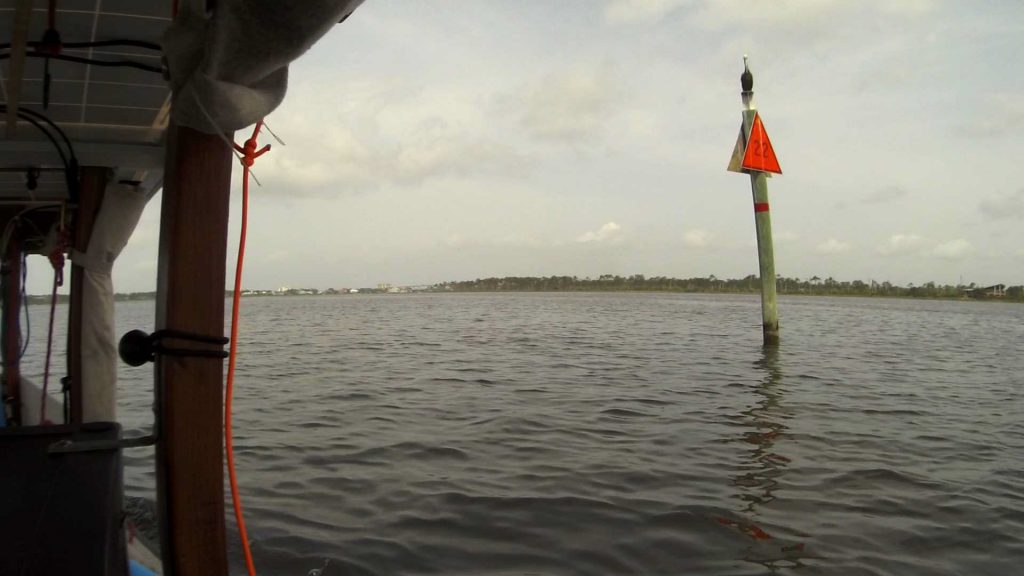
I’m glad to hear you are back in the water. Sounds great. Somehow I didn’t get to the water all year. Now it is too cold to stay out on the boat overnight.I like pelicans, too, from a distance. It is funny how they almost always travel in squadrons. 8 or 10 of them will sit on a floating log or do a fly-by. Sometimes you see solos sitting on a navigation marker or an old piling and sometimes you’ll see a busted up dock with dozens of them. Out in the Gulf of Mexico there are some large channel marker structures that look like pelican storage units or maybe condos. UWF has a dive barge over a 1559 Spanish shipwreck. First duty after a hiatus is to fire up the dredge pump to wash the thick, foul layer of pelican crap off the deck. OMG that stinks!

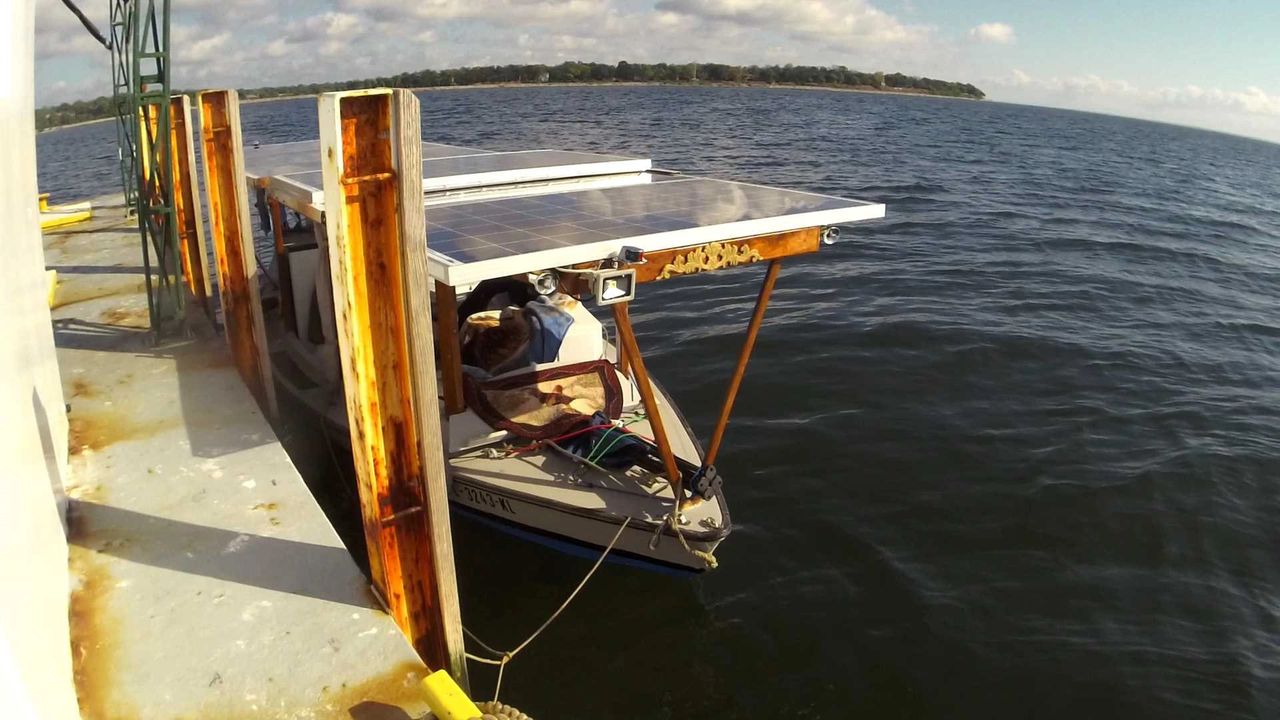
In Mobile Bay, I saw a little tern land on a pelican’s back to try to steal food scraps. The pelican was having none of that and snapped at the little guy! If you are in a solar-powered boat, though, you yell at pelicans and wave a life jacket. Pelicans look at a solar boat and think, “aircraft carrier.” No way you want pelicans doing to all those solar panels what they do to the dive barge!
The range of pelicans amazed me. I thought they were coastal birds. Not so, they go where there are water and fish. I saw them on the Mississippi River in Illinois, of all places! I don’t remember them in Pensacola, as a kid, but now they are everywhere, as are gaudily decorated pelican statues, in downtown. Somehow the pelican has become the town bird. Enjoy the art show. By:Neal Collier
Solar Heat
When my grandfather came to this country over 100 years ago, he worked his way around the US and Canada learning English and looking for just the right spot to establish a farm. About 1920, or so, he found the right spot on the shore of Lake Okeechobee, in Palm Beach County, Florida. It was heaven for a Danish farmer, with a climate that allowed year-round crops. Solar power was already a big deal in South Florida back then, even before John started Sun Electronics!You think I’m making this up? I’m not, but I’m not talking about solar electricity, either. I am talking about solar water heating and it was a big deal in Florida. In the late 1800s, a guy in Baltimore, MD, invented the self-contained Climax Water Heater. It first caught on around Baltimore, as you might expect, but was a hit in Florida. Why? My best guess is that South Florida has plenty of sunshine and, in those days, was very cut off from the rest of the country, causing fuel to be expensive. Until Mr. Flagler’s railroad, a ship was the best way of getting to the budding paradise.A Climax Solar Water Heater cost around $25, back when that was some real money.

Solar water heating kind of fell by the wayside at some point as gas and electricity became common, but guess what I saw in the Sun Electronics warehouse when I visited a few weeks ago? Solar water heaters! They are a lot more sophisticated and efficient than the early ones, using heat pipes and evacuated glass tube technology. They look kind of like this.
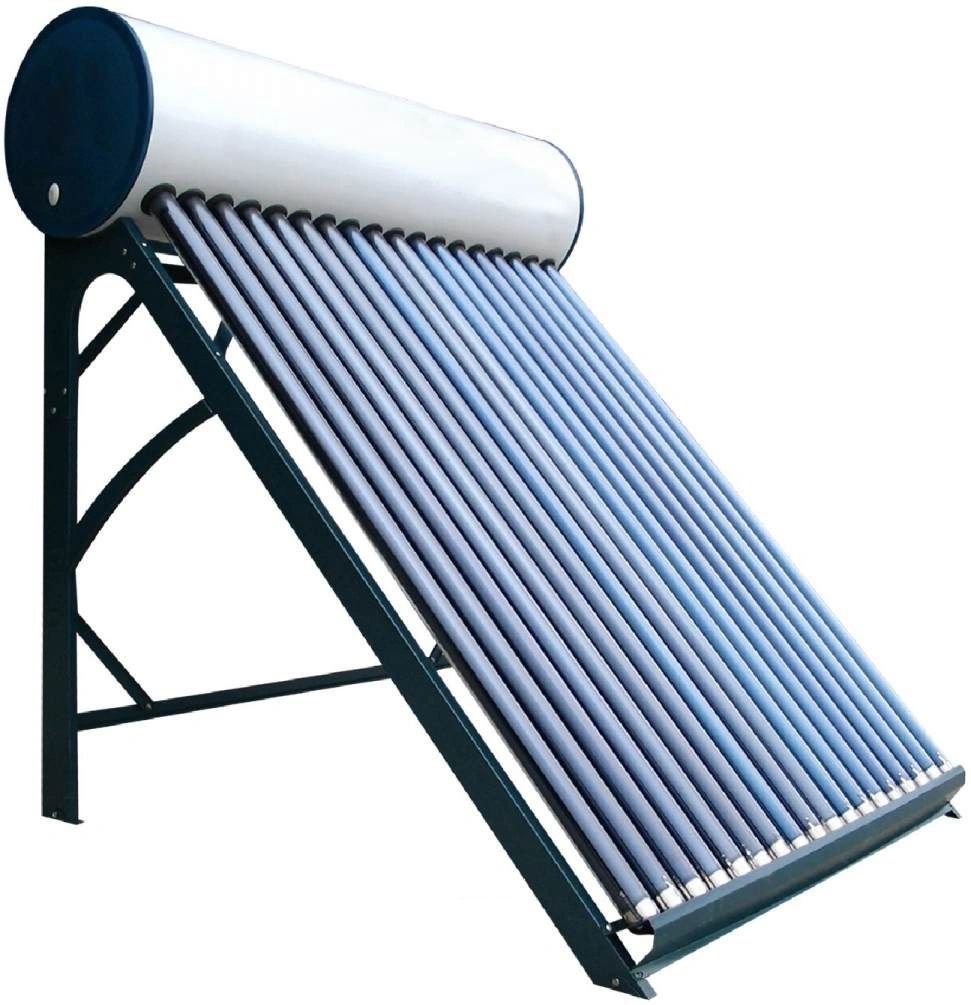
The tank is stainless steel with a thick foam insulation layer. Those blue tubes are magic! Not really, but they work like magic, pulling in the heat. Sure, you could use one of these babies on your suburban home to save on the power bill, but imagine the luxury of hot showers at your remote cabin or house in the boonies or on your own personal island. A remote abode would have you in pretty much the same situation as old Coral Gables when you couldn’t just call the propane truck to stop by and top up the big gas tank to fuel a water heater. I also saw solar ovens in the warehouse. Most of us would probably think of these as a novelty and only use them for camping, but I am thinking they’d be handy in case of an emergency, like for those folks camping out at Mexico Beach, where their houses used to be. There are places around the world where peoples’ health is ruined by the smoke of cooking fires. I bet they’d love one of these. The real surprise on the water heater, though, is the price. Sun’s prices are about half what some other places charge, just like with their solar panels. I wanted to figure how that compares to the prices a century ago when they paid in silver dollars. Looks to me to be about the same, now, as buying 25 Silver Eagle coins, even though the modern heaters are more efficient and durable! Solar thermal power has been put to use for a long time. Even Mom’s old black cat sits in the window of the sun porch and uses it. Why not us? By: Neal Collier
Efficiency
Going through my morning email newsletters, I came across a press release from a company called LONGi, announcing a new record of solar module output efficiency of 20.41 percent! The exclamation mark was theirs, because another tenth of a percent doesn’t get me all that excited. Last week some outfit announced their record output of over 40 percent. A close read of that announcement showed that their output was achieved with concentrating lenses. Concentrating lenses in turn require that extra effort must be made in getting stuff pointed straight at the sun or everything goes to pot in a hurry.
Any solar module will output more electricity if you put more light on it. The problem is that in addition to the extra complications and power, you get extra heat. Some years ago somebody was selling used panels from a concentrating solar farm and they looked like trays of fresh-baked cookies, all warm and brown.
Sure, somebody with special limitations on weight or available space may benefit from superduper efficient panels, but you can count on special panels having a special price. For my solar boat, the standard “B” modules I used were cheap, but heavy. I compensated by just making the roof a little lower instead of spending way more for lighter modules and the boat has so far stayed right side up. Always have the bottom of the boat heavier than the top!
If you have the space, though, the real efficiency in a solar power system is how many watts you can get for your dollars. More solar sellers seem to be using that criteria in their advertising nowadays, showing a price in $/W. This is seems to be a trend that John started with Sun Electronics, as I have always seen his panels priced that way.
Many of the panels in my array are, shall we say, not “Grade A” and I am happy if they put out anything close to the label rating, regardless of theoretical efficiency. I’m building power levels by shear quantity of modules, counting my efficiency in pennies per watt. As for improving efficiency, blowing the fallen oak leaves off the array helps and it would probably be a good idea to break out the long-handled scrub mop every now and then… it helps!
So, if your idea of efficiency is getting the most for your money, give the Sun Electronics crew a call. They almost always have deals that are even better than the published prices.
By: Neal Collier
Backup Power System, Part 3
I have been rambling about backup power and it is time to touch on the batteries and other topics. My advice on backup batteries is a little different than for solar systems. I advise that you get something that requires little or no maintenance. The reason for that is that you will probably lose interest in a system that just sits there doing nothing when the power company is doing there job, because the lights are usually on! Out of sight, out of mind. If you have flooded batteries (as I did) tucked away in an obscure place (as mine were) then it is quite likely that you will get lax about monthly waterings (as I did). If you don’t water flooded batteries, they lose power and start to emit acid fumes. Acid fumes eat up your terminals and battery racks and cause circumstances that are a lot more unpleasant than simply adding water.
SO, the best advice I can give is to use some sealed batteries, like AGM or some of those new-fangled lithiums. John has both kinds. You’ll find that AGM costs twice as much as golf car batteries and lithium…OMG. Well, that’s upfront costs. It may well wash in the long run. If the charging system is set up right, the AGMs can last twice as long. Lithiums last a lot longer and you can draw them down further without hurting them. That means a little lithium will keep the lights on as long as a bigger lead-acid model of same amp-hour rating.
There are all kinds of batteries out there, but these are the big players, the likely suspects. Just make sure you DON’T overcharge the AGMs and DO have a good battery management system (BMS) on the lithium. BMS is often built into the batteries and sometime come as a bolt-on.
Now, on another subject, did you get the Sun Electronics Christmas Eve email blast? You guys really need to read those things, even if John doesn’t make it easy. It was just a list of part number, quantity available and price. No real description. I got around to reading it Christmas day and decided to use the Miracle of Google to decipher some of these things. HOLY COW! I found that the listing “Outback PS1-3000” was a package that would allow you battery backup, grid-tie or the bones of a complete solar system. Charge controller, grid tie/hybrid inverter, breakers, surge protection, battery box, network control and more in one nice package you can bolt to the wall. They sold before I got to them because the price was $500 for a $5000 package!!! READ YOUR EMAILS!!! Somebody did and got all 3 of them.
Now, on the PS1-3000 package, this has been discontinued because there are some new rules about rapid shutdown. Outback came out with a new system that is similar, but has the rapid shutdown built in. Roberto, or one of the other salesmen, can give you the model number and price if you are interested in a package deal from a good maker.
That’s all for today. Next time is a time of soul searching and self-evaluation when I try to answer the question, “Can I install a solar power system myself?”
By: Neal Collier