


Cut Out The Middleman
Utility power began with a fight between AC and DC systems. Thomas Edison promoted DC distribution. His ex-employee Nikola Tesla, the real Tesla, came up with the AC system for George Westinghouse. Both sides advertised how dangerous the other way was! What a way to promote a new industry!
Power stations were not the huge plants of today. They’d be tucked into a building on a corner and lines would run out a few blocks in each direction. There was no grid. The first microgrids?
DC lost out because you just couldn’t send it very far without a voltage drop. AC could counter the drop with transformers to boost the voltage. With this extended range, The power plants could be bigger and send the wires out further. Plants were also interconnected and the grid was born, making for more reliable power…except for country folks.
Country folks had to make their own electricity, usually using a gas generator like the Delco Light Plant, a Jacobs or Wincharger windmill, using battery for storage, or even a small hydro plant. Henry Ford had a hydro plant on his estate. These systems were the forerunners of the independent power plants you and I are building with the clean and quiet solar systems. They fell by the wayside when the Rural Electric Administration began subsidizing power cooperatives for the rural areas.
The power companies started dabbling with solar when they saw how many of their customers were adding solar. Prices dropped and then solar became cheaper to build and WAY cheaper to produce power, even when they had to buy batteries, which are now all the rage. The power companies began building solar farms. Then they started a campaign to discourage or even prevent US from building solar capability for ourselves. Recent power industry sources now openly admit this.
Here is something a little funny, though. They seem to be on the verge of dismantling the grid system, at least on a small scale. Recently, an Australian power company was faced with upgrading a line to the boonies. Instead, they cut that project and installed small solar plants at the far end of the line. The customers saw no difference and the power company both saved money and still retained control of the power. You have to wonder why the ranchers didn’t just make their own solar plants and be done with power bills. Closer to home, a long line in the Appalachians avoided an upgrade by adding battery. This morning, I see a report that ConEd, Mr. Edison’s company, is working on alternatives to upgrading lines that are struggling under peak conditions. It won’t surprise me if they eventually add solar in the mix. Puerto Rico’s thoroughly screwed up system seems to be moving to solar and microgrids.
So, the question is, if the power company admits that solar is the way to go and solar is cheaper than conventional generation, why isn’t everybody doing it? Probably because of the upfront costs or maybe the word just hasn’t gotten out that the upfront costs aren’t that bad. John’s sales guys have payback examples for their package systems. Take a look and you may decide it is time to cut out the middleman, or at least have some backup and independence in the event of a utility power failure. My lights don’t go out. Ever. Not for 25 years. NICE.
By: Neal Collier
New System, Problems, Solar Daiquiris
Stan-the-Hermit called Friday, needing some bits and pieces to finally get his 24v solar power system running. He’s had his panels for well over a year, having accompanied me on my final run to John’s old Miami Gardens warehouse. They’ve been mounted for months. He left my place happy with an armload of switches, breakers, fuses and solar wire. If I had more friends like Stan I could open a solar hardware store.
I expected to receive a triumphant phone call within 24 hours, but that didn’t happen. He was in a panic when he called Saturday. He’d hooked it all up right, he claimed, but the voltage on the batteries had gone from 17v down to under 13 overnight. What could be wrong? The answer is right there, but let me give you some background.
A while back Stan told me he’d found a Great Deal on some used batteries that came out of a motor coach. “Great Deal” and “used batteries” can, but do not always coincide. Given the voltages he quoted at the time it was clear that they needed a good charging and equalizing and that one might have a dead cell. He did not charge them, resulting in 4 six volt batteries adding up to 17 volts when he connected them in series. I suspected I knew what the problem was and asked if he had read the manual.
“I hooked it up right,” was the answer, but not to what I had asked, so I asked twice more. No, he had not. I braved 4 miles of bone-crushing gullies, terraces and switchbacks to get to his cabin to take a look. He had hooked it up right, as he’d claimed, but it was settled in on 12.8v, which is fine for a 12v system and a real problem for 24v. He could not find the manual, of course. I suspected the charge controller had autodetected the system voltage as a well-charged 12v system and proceeded to run the battery down to 12v overnight.
We hot wired two panels directly to the batteries to get them charging. I left him with instructions to let them get up to a bit over 30v so they could equalize and desulphate and to keep an eye on the water levels. Batteries that dead should have taken a few days, but he was impatient. By Sunday morning the voltage level had come up to 27 volts and he was ready to hook up the charge controller and inverter. That is not what I had prescribed, but it would not hurt anything and might save some damage that could occur if he went away, leaving the batteries unregulated.
I stopped by about 6:00 Sunday afternoon and Stan was a happy camper. I poked at the charge controller and saw that the battery was still taking
50 watts, even as the tall trees up the valley slope were shading his panels. He’d had some of his inner circle over and they’d inaugurated the new 24 volt power system by making daiquiris! It was clear they’d been successful in that endeavor.
He still has 8 more panels and another charge controller to connect before it is done. When he moves his Flexmax 60 over from the 12v system it will be just the ticket for getting those batteries equalized because it can be manually set up for a thorough job, unlike a lot of other controllers that give a mild boost on a daily basis.
By the way, I found the manual online and his charge controller autodetects a 24v battery in a range of 18-30v, so it really did think it was dealing with a 12v battery. Whether you buy your batteries new or used, charge them up before storing and again before putting them into service. Just sitting around discharged is bad for them and confusing to a charge controller. RTFM (read the fine manual).
As for what you use to test your new power system, a blender is as good a start as any.
By: Neal Collier
Time to Hang it Up!
I like wristwatches, especially ones with classic art deco styling. I quit wearing them when I had my hands in commercial radio transmitters a lot. Other people got away from wristwatches for a while, having their phone has an accurate timekeeper, but watches are making a comeback. They are becoming quite the investment, too.
If you have a Patek Phillipe Grand Complications Celestial model, you probably have your people work on your solar system. I leave the Girard Perregaux Gyromatic in the watch box when I am just knocking about, preferring one of my big Timex Weekender variants because I can see the contrasty face with my iffy eyes. Whatever is on your wrist, maybe it shouldn’t be when you are working on your solar power, or any electrical equipment.
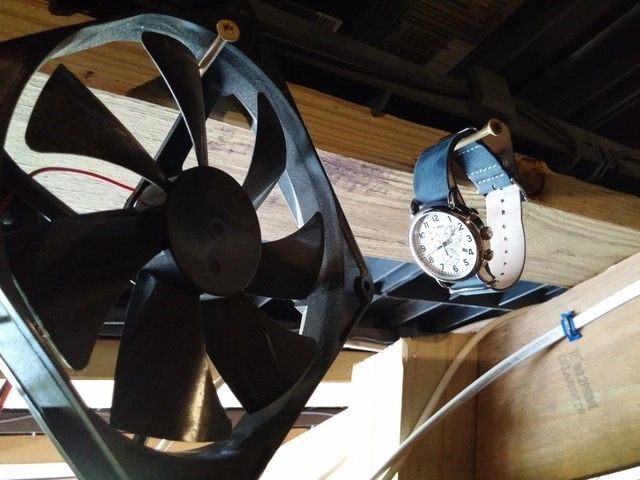
One of my pieces of safety equipment is a long screw on a low rafter, off to the side of my control panel. You could use a nail or, if you have a finished room, maybe something civilized like a Shaker peg. That’s to hang the watch on, along with any rings or other metallic accessories you might have.
Whether it is a Timex or a Tourbillon, hang it up when working around power.
Getting a watch into solar string voltages will make for a real nice conductor, allowing you a fairly quick, if agonizing death. A 12v battery might well weld you into the circuit and give you an awful burn. The nylon or leather straps on two of my Weekenders make them smaller targets, but targets just the same. Getting into a 24v circuit with a Twist-o-Flex you might be able to save the hand if you are fast enough. The heavy stainless bracelet on my Wittnauer or my Lord Elgin in contact with a 48v circuit might well just burn the hand off as the band vaporized.
Sorry to sound so gory, but safety is no accident. In this case, prevention costs a couple of cents for a nail and a few seconds of your time. Hang up that Portugieser and get to work!
By: Neal Collier
Why not?
I figure anybody who has built a solar power system has good reason to take pride in their work. I know I am proud of mine, but now I am a little dismayed. My system is just a solar-roofed shed. It is practical and it works, which is fine, but now I have seen that others with a little more room and a bigger budget are also having fun with their systems. I am jealous.For example, there is a Duke installation at Disney Orlando, like you couldn’t figure that out for yourself.
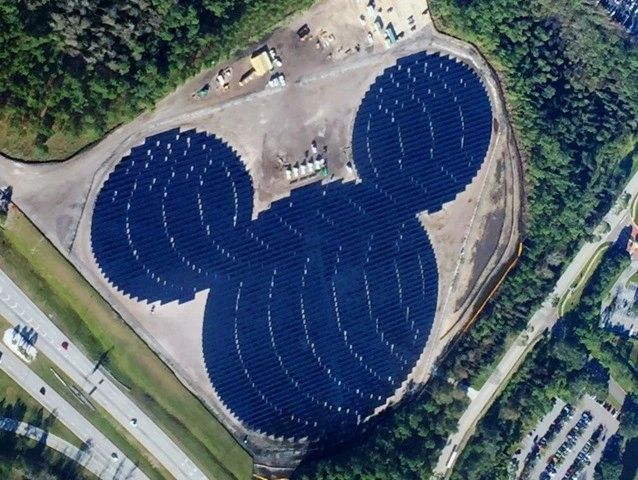
And what is the national symbol of China? The Panda. There are over 100 panda-themed solar power stations in the works. The photo below is a design rendering, but this station is now on line. They use different panel coatings to get the shading.

Fiji is getting in on the panda craze, too, though this one looks crudely photoshopped.

And here’s a nice one in the “heart” of New Caledonia.
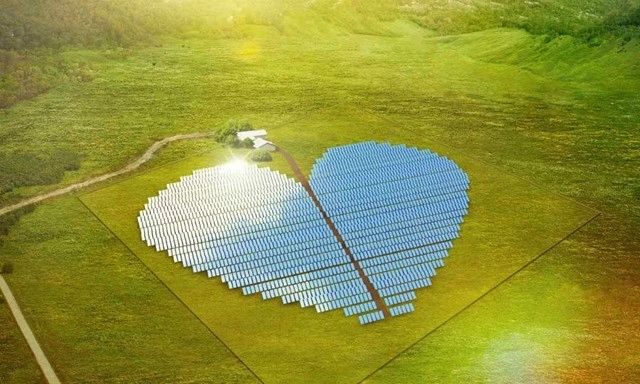
Y’all make some solar power, but let’s have some fun with it, too!By: Neal Collier
Waiting my turn in Nawlins
Is that a smile or did I just put my elbow down on a hot PV module? I’m catching some rays through the sliding module hatch of my solar expedition launch, Sun King. This is at New Orleans, home of the weirdest lock and drawbridge combination I have ever seen. 1620 watts of “B” panels on the boat.
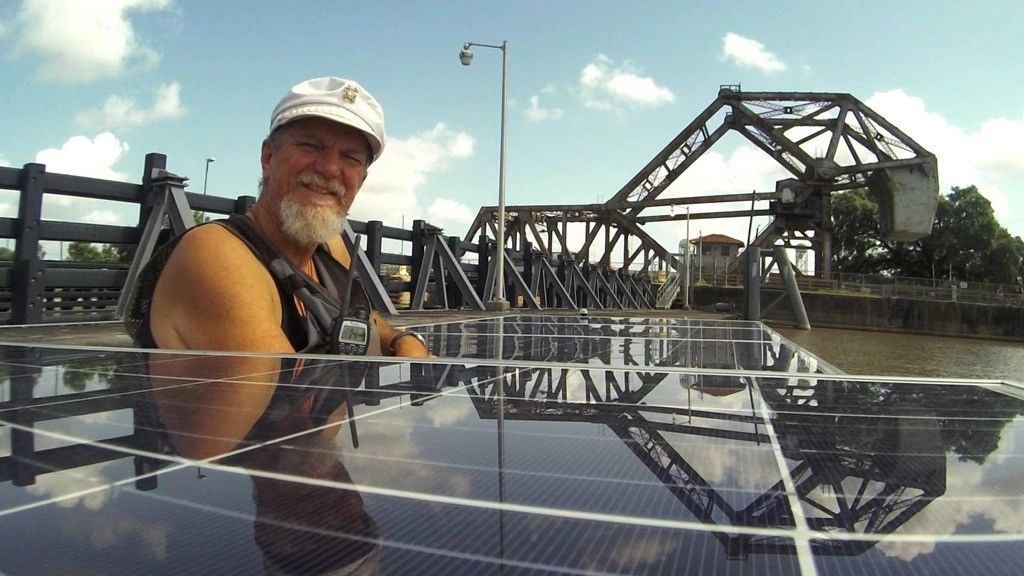
Are you afraid of “B” panels? I’m not. I put six of them on my solar-powered expedition launch Sun King and travelled up to 1000 miles from home. My longest trip was 1920 miles in 44 days. Lots of rivers and the Gulf of Mexico. These days I don’t wander so far off and only have 3 modules in the middle and rounded edges on ends. 9 big 335 watt panels are going on my solar yacht project and I plan on taking that on a 6000 mile trip around The Great Loop. “B” panels are reliable and cheap, so you can afford more solar stuff, like batteries and charge controllers, all of which Sun Electronics has, of course.
Just planning to keep the batteries charged on your sailboat or cruiser? Save money with so-called 24 volt panels instead of 12 volt panels. Use an MPPT charge controller and the 24 volt panel charges your 12 volt battery bank at top efficiency. By: Neal Collier
Solar everything, even the honey dipper!
If you spend much time around boats you know that you can’t just flush overboard. The holding tank has to be pumped out on occasion. Now there is a solar-powered roving pump station.
In my opinion, they got this wrong. There is way too much motor on this thing, probably because it was set up by the motor maker. Or maybe they can actually get that rig up on a plane, for speedy service. Torqeedos have a fair reputation if you can tolerate the noise they make. Where it is underpowered is up top.
They are going to have to plug this thing in at night if they use it much or if it has to travel very far. It is a FREE service for boaters and won’t use any gas, so I shouldn’t be too critical.
By: Neal Collier
Photo credit to http://www.solardaily.com
Inquiring Minds Want to Know!
Over the weekend we really went to extremes to show just how tough solar panels can be. Today we’ll tell you the results.
We started with a Suntech STP280 that had been hit by a tractor. The frame was bent, wires were ripped loose, glass was shattered and many of the internal cells were broken. Short circuit current of a shiny new panel should be around 8 amps. Open circuit voltage should be 44V. In the “as found” condition, we had 4.5 amps and 43 volts. Connected to a load we could get about 68 watts. Not bad for a module someone had thrown away.
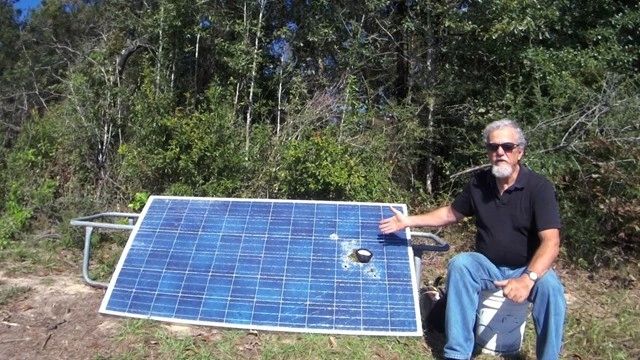
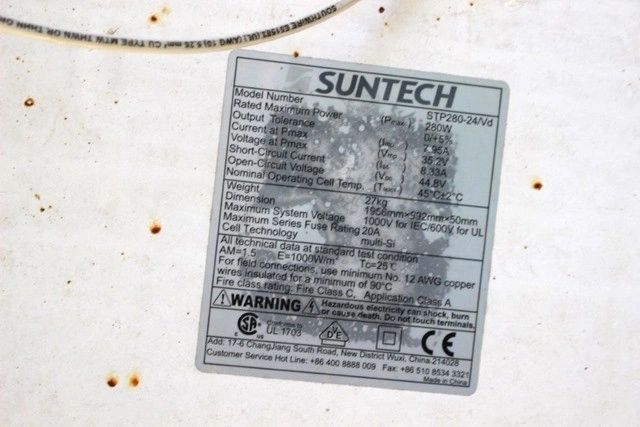
Especially for a panel that looked like this.
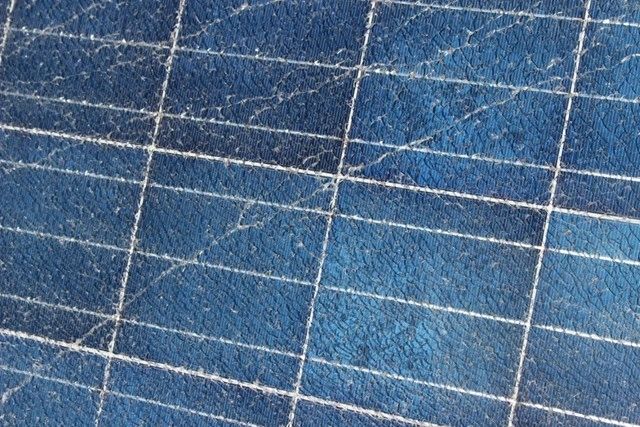
And to recap what happened next:
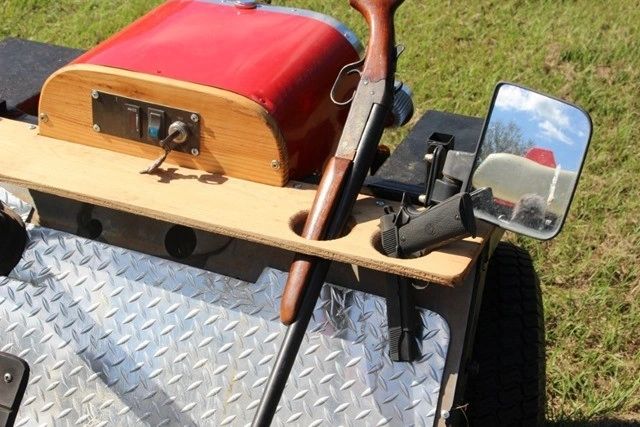
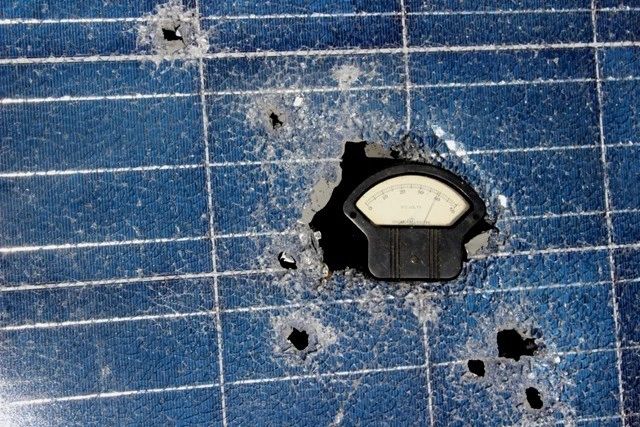
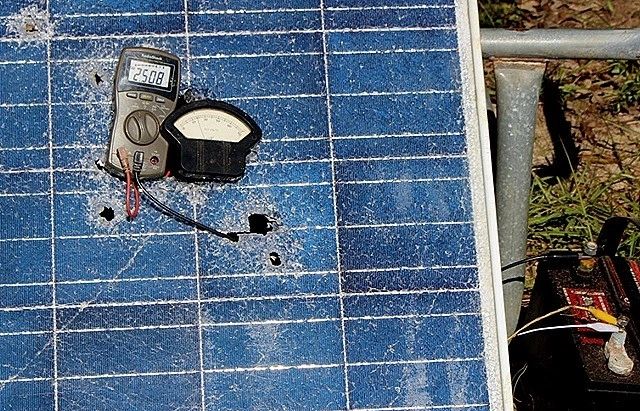
After the shooting, I measured output under varying conditions. The hole sure was a handy place to put a voltmeter!
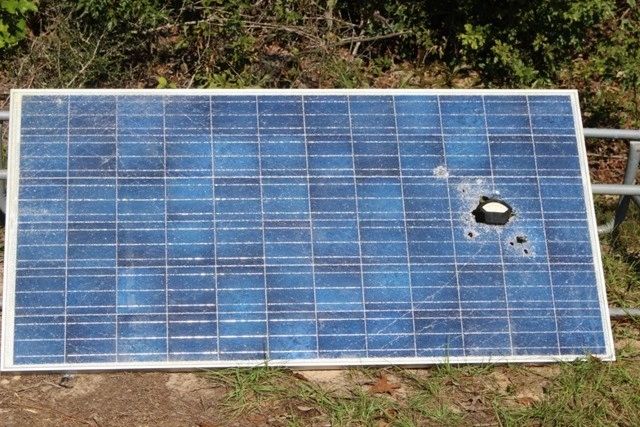
And the open circuit voltage was….39V.
Next I added a 24V driving light as a load. The lamp pulled .961 amps at 24V or 23 watts. That’s all the lamp needed. Was there more?
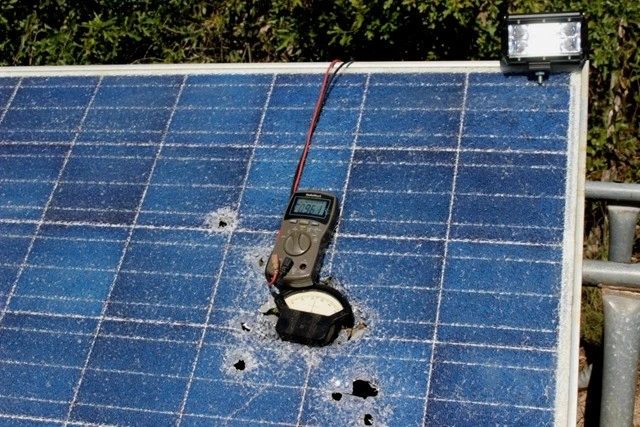
Next, I added a 12V battery, to be charged, and an ammeter.
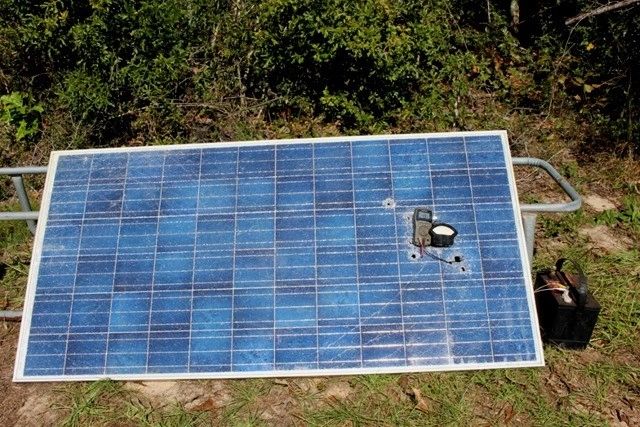
Now we have 2.508 Amps at 13.8 Volts for 34 watts.
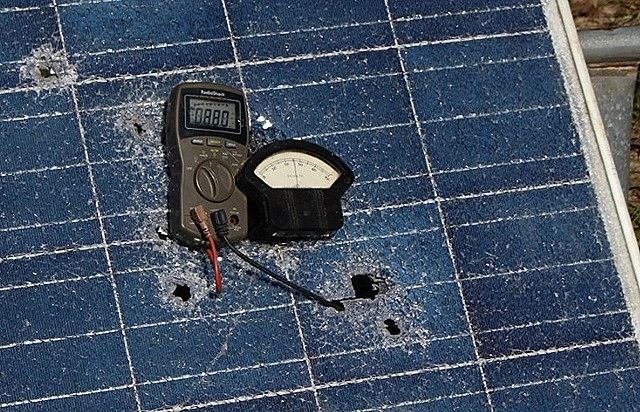
How about 2 batteries in series and the light? 26.2 Volts X .880 Amps = 23 watts
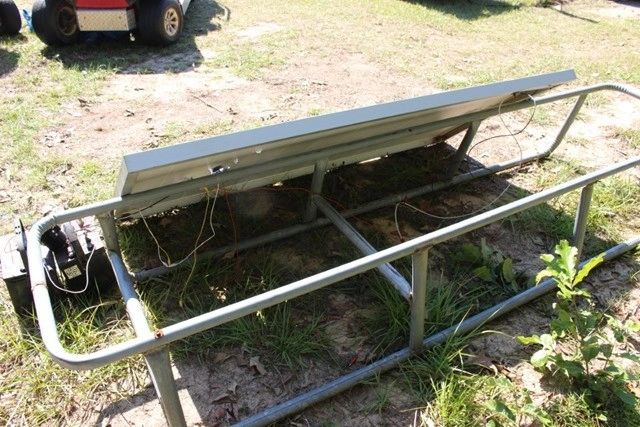
Here’s a look behind the scenes…no trickery, just honest destruction.
Conclusions? Obviously, PV modules work better if you don’t smash them with a tractor, shoot them with a pistol and shoot them again with a shotgun. The worst damage appears to have been done by the tractor. That hit took it down from 280 watts (rated) to 68 watts. The first two shots, from a .45 and a 12ga. slug, had no effect on the output. It was the huge hole from the shotgun when I backed up that cut the output in half. The point is that the panel continues to output usable power and it did a good job of topping up those batteries.Oh, and remember “Don’t Try This At Home.”By: Neal Collier
Here’s a handy idea for after a storm
You know those little solar sidewalk lights? You can put them outside during the day and bring them in at night. I wouldn’t read by one, but you can find your way around the house with it and it is safer than a candle. Most of these have a AA or AAA battery in them, either NiMH or NiCd. You can put regular alkaline AA or AAA batteries in them if you want them to run all night.
Just keep them inside and they will last for days, if you don’t want to worry about someone stealing them or have them submerge when it floods. Whenever I remove a battery that won’t run the blood pressure machine or other small gadget, I put it in a box if it has any life left in it. They will still last a long time in a super low drain application like running that one tiny LED in a garden light!
This works in a condo, too!
By: Neal Collier
Battery Connections Illustrated
Elsewhere in the blog page is a post about battery safety. I have a couple of battery photos to illustrate what I was talking about the other day, easily making battery polarity easier to see. The old 24v battery strings have decent cables, grease to seal out corrosion, but they are a bit dirty and it is hard to see the polarity, should I need to reconnect anything. You can see where I marked the 2 gauge cables + and –.
The batteries do get cleaned up every time I add water and it is about that time.
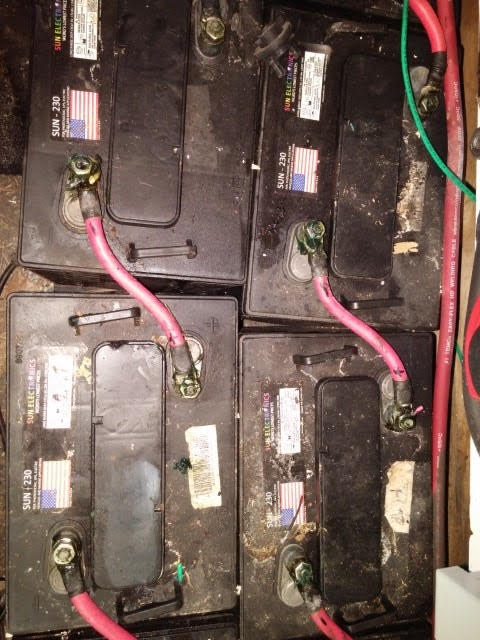
Here’s the new set for the 48v system, with painted corners to mark polarity, color coded heat shrink on the 2/0 cable terminals, dates on the batteries, grease on the seal and the terminals. This is much easier to identify things. In lieu of shrink tubing, you can get electrical tape in different colors, too. Batteries are the SUN230 golf car style from Sun Electronics.
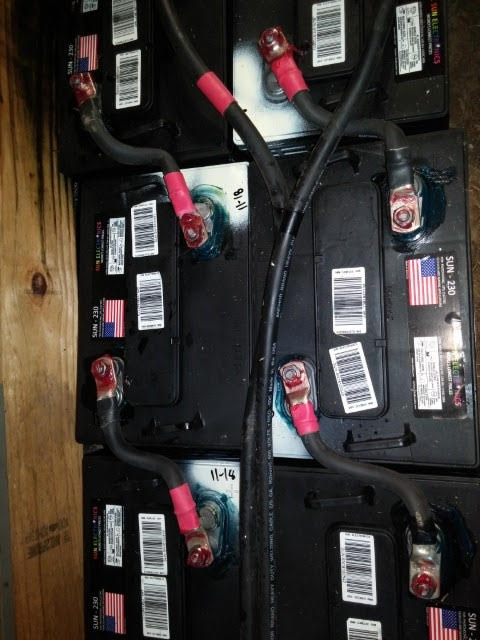
When the new wall goes in for the power room, I will build a proper battery box to keep out the dust and dirt. I use plywood and 1×2 strips painted with latex paint. My last battery box was nearly 30 years old with no acid damage because latex paint is acid resistant! The original battery rack was steel and was in pretty bad shape after those years. I have gone to wooden racks and they seem to work well. I’ve never had any worry about fire, but lining the box with latex painted drywall will ensure that nothing burns.
The floor gets painted with latex, too, and I put in a layer of vinyl flooring. I leave a dusting of baking soda on the floor, just in case, and keep a box or two of baking soda around to neutralize any acid spill. Of course, John sells sealed batteries if you want to avoid that issue.
By Neal Collier
In defense of crappy free solar roof tiles
John’s right, the quest for attractive and practical rooftop solar with these tiles was a flop. Some of it was design flaw and some of it was improper installation. I hope Mr. Elon Musk, who is marketing solar roofs, has investigated this matter lest his quest should fail as well.
Stan-the-Hermit poses with 10 conventional panels for his cabin power upgrade and 300 roof tiles at the old Miami Gardens store.
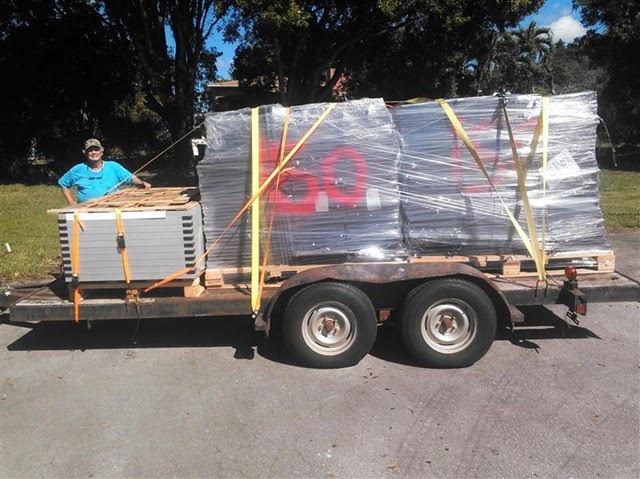
I know about the tile problems because I have hundreds of these tiles. No solar panel works well when it is hot. Screwing them to a plywood deck leaves no space for cooling air circulation, inviting poor performance, at best. The heat also affected the wiring, some of which was made with insulation that lacked the proper plasticizers, so it just crumbled away. The heat and a poor choice of sealant caused the glass to separate from the cells, on some, allowing moisture to corrode busbar connections. The way roof shingles are installed, you can’t just pull out a bad one and replace it. You have to remove everything above it to get to its 4 screws. If one of a string of 200 goes bad, then you have no power. And, let’s not overlook a worker’s ability to screw something up. Many of the tiles I got never had all of the screws installed and some had pinched wiring. Combine high heat, 600 volt string potential and bad or crimped insulation and you are just asking for trouble. While none of these tiles ever burned down a house, there were a few smokers.
Then, consider their deinstallation. Very few I have received did not have the imprint of a size 11 boot in the grime on the glass. They were walked on, stomped on, thrown off the roof and piled high, sometimes with screws still in them. A few were hit with hammers. The result was some broken cover glass and most have cracked cells.
Some recycled roof tiles may require adjustment before use.
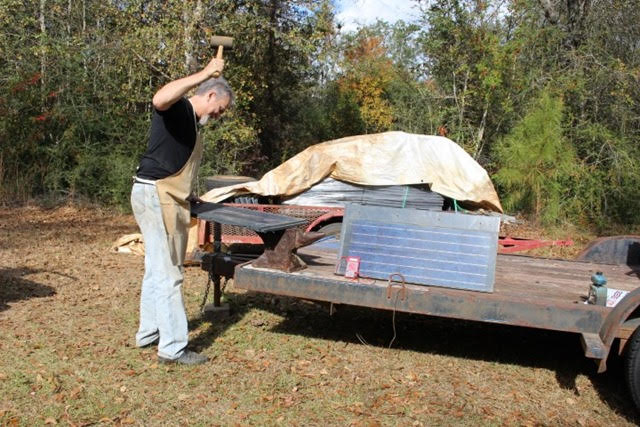
So, why would anyone want any of these? For one thing, they are pretty much free. For another, even if they don’t work, you can cut off the wires and make a good roof for a shed or carport. I’d reroof my 50×64 barn if a container of duds showed up at my place. The thing is, though, a lot of them do work and making a few changes in how they are used can make them practical.
First of all, don’t put them on your house. That is a contractual term of acquiring them. A shed, lean-to or outhouse is ok. One guy was going to mount them on a radio tower! In shed construction you don’t need to use a roof deck. Put up trusses or rafters (the sloping bits) and string 2×4 purlins across them at the appropriate spacing and start screwing down the panels with deck screws. This gives cooling air circulation underneath. It also gives access to the wiring so you can simply bypass one that fails with an MC3 jumper cable. No muss, no fuss.
This is how I’d do it. Just sayin’…. Solar Shed, phase one. If you don’t need a shed, use shorter posts.
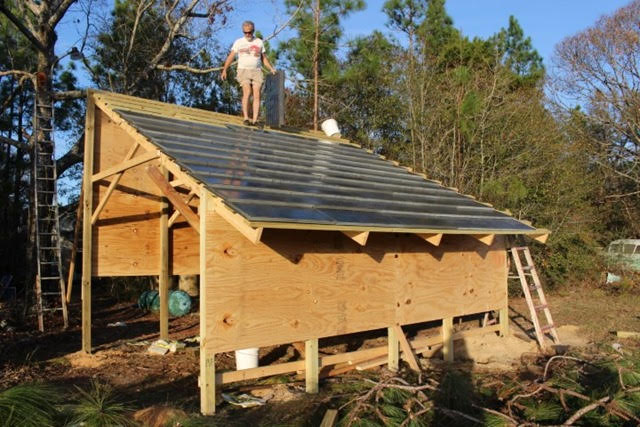
Easy access to the wiring. Easy construction.
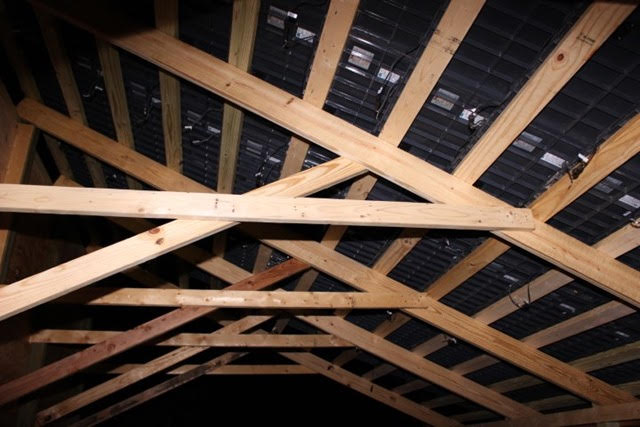
Then, connect a modest number of these low voltage modules in series as appropriate for your charge controller. In my Solar Shed project, I use strings of 21 on the 30 amp MPPT controllers on my 24v system and 4 strings of 21 for my 60 amp controllers on the 48v system to which I am transitioning.
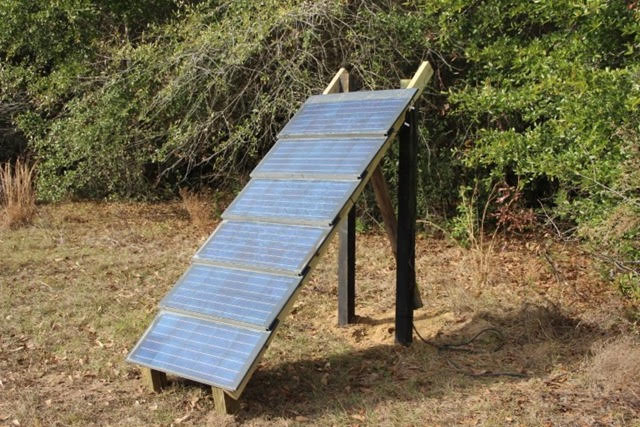
For a barn power supply and a water pumping station, I install two 4×4 posts about head high and two shorties, with 2×4 inclines between the tall and the short. The shingles are screwed to those. 3 shingles make about 100 watts at 12v with a cheapo on/off charge controller. You can add blocks of 3 to your heart’s content.
This easy setup runs my backup water pump at the far reaches of my property. 24 volt pump and no battery. A similar setup, with battery, lights my barn.
Back at the Solar Shed, on the first 16′ section I learned to avoid the panels with delaminated edges. They are trouble. I did not put up any with broken glass, but accidents happen and I have a broken one. It does not leak and it makes electricity. Because I have access from below, I have been able to jumper out two of the delaminated ones that quit. Their bypass diodes should have done this automatically, but it seems the heat was not good to the diodes. A $20 infrared thermometer gun lets me check for hotspots underneath.
The second 16′ section has had no failures. The new 38′ section, so far, does not have a single panel that does not contain cracked cells. Want to know a little secret? As long as the silver strands are intact, cracked cell perform better than whole cells? Will they last? Who knows. Live for today!
Phase 3 of the Solar Shed in progress, as of last week. The big panels are for the Solar Yacht project hardware evaluation. Yeah, a Phase 4 is planned.
Live for today! Phase 3 of the Solar Shed in progress, as of last week. The big panels are for the Solar Yacht project hardware evaluation. Yeah, a Phase 4 is planned.
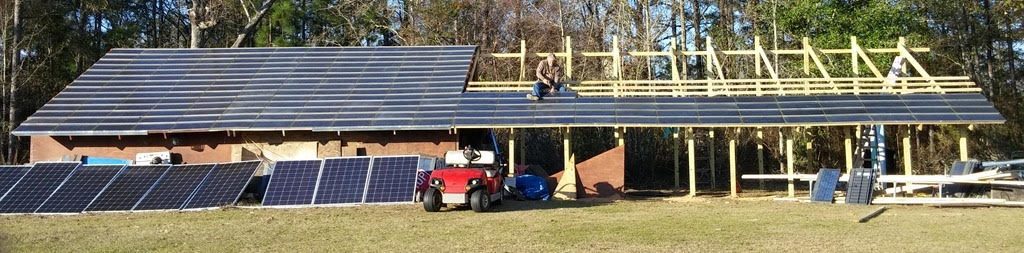
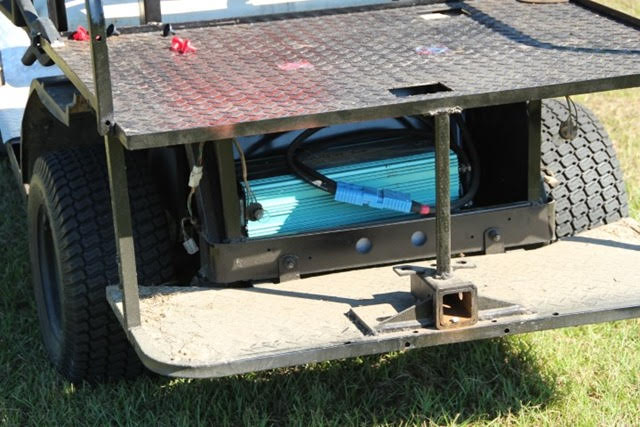
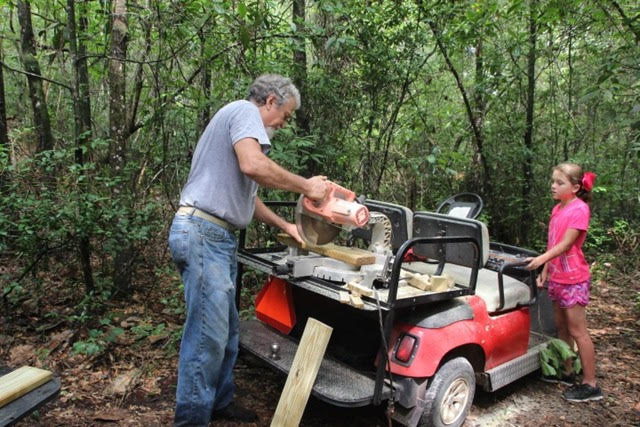
Is it practical? You decide. I charge my fleet of two electric farm vehicles, reworked golf cars. They allow me portable electrical and mechanical power over the entire farm. I run lights and tools at the solar shed, even a 2hp air compressor. I welded up the solar jalopy with this power. All construction on the shed was done with solar power (the first section power came from my solar boat). A line goes underground to the house to the emergency power circuit I had for the generator and battery backup, so my lights, office and kitchen are powered by these crappy plastic roof tiles. That’ll be 11KW of cheap plastic power when the current section is done, which means free air conditioning this coming summer!
Take your solar power with you with an inverter-equipped solar-charged electric farm jalopy.
Building the bridge to nowhere with portable solar power.
In the unlikely event that all of the panels quit, I’ll still have a useful shed with a free roof. There are plenty of others who dragged these home. How are you using them? –Neal